
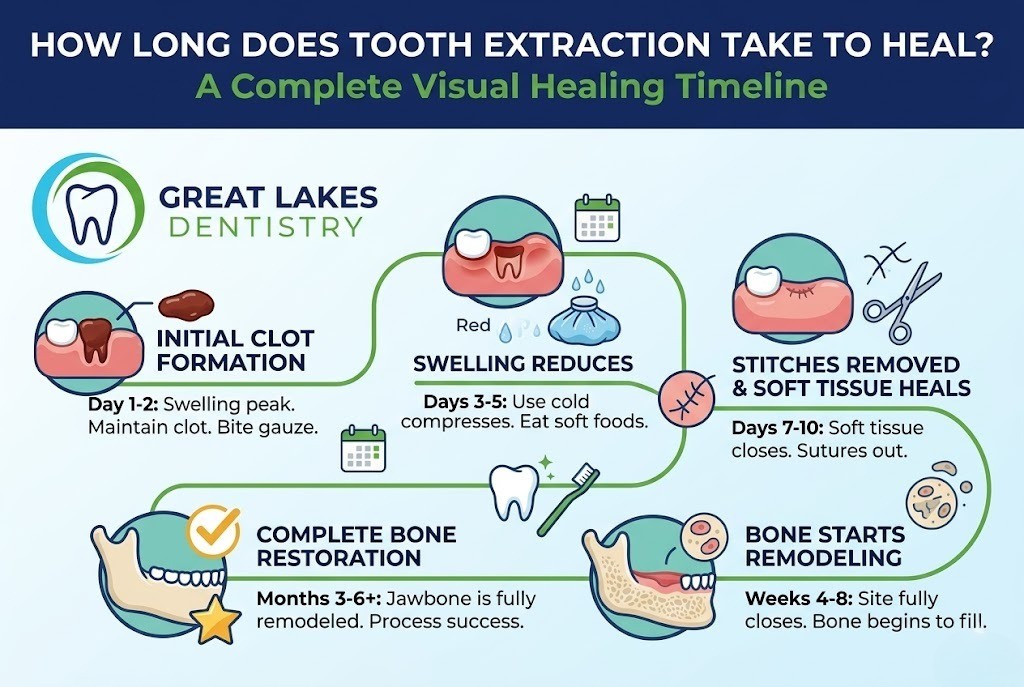
Understanding the full tooth extraction healing timeline at Great Lakes Dentistry in Oakville, Ontario
Most patients leave the dental chair with one question that no amount of gauze can quiet: how long is this actually going to take? The honest answer depends on the type of extraction, how well you care for the site, and a few biological factors that vary from person to person.
At Great Lakes Dentistry in Oakville, Ontario, we follow the clinical guidelines set by the Ontario Dental Association and the Canadian Dental Association to ensure every patient receives post-extraction care that meets national professional standards. This guide breaks down exactly how long tooth extraction healing takes at every stage, what slows the process down, and the signs that tell you something needs professional attention.
Tooth Extraction Healing Timeline at a Glance
Before diving into the detail, here is the straightforward timeline most patients follow:
Surface Healing
- Blood clot forms within 1 to 2 hours
- Initial soft tissue healing in 3 to 7 days
- Gum tissue fully closes in 1 to 2 weeks
Deep Healing
- Pain and swelling improve in 3 to 5 days
- Deeper tissue heals over weeks
- Full bone remodeling takes 3 to 6 months
Pain and swelling should improve significantly within the first 3 to 5 days. If yours is not improving by that point, that is the first sign something may need professional attention. Patients covered under the Canadian Dental Care Plan can access follow-up appointments at reduced or no cost depending on their eligibility, making it easier to get prompt care if your recovery raises any concerns.
Day by Day: How Long Does a Pulled Tooth Take to Heal?
Knowing what to expect at each stage removes the guesswork from your recovery. Here is exactly what a healthy healing timeline looks like.
1. Day 1: The Clot Is Everything
The first 24 hours after a tooth extraction are the most critical window of the entire healing process. A stable blood clot must form in the empty socket to protect the underlying bone and nerve tissue and to serve as the foundation for new tissue growth.
What a Healthy Socket Looks Like on Day 1
- Dark red blood clot sitting in the socket
- Mild oozing that gradually slows over 24 hours
- Noticeable soreness once local anesthetic wears off
- Some swelling beginning to develop around the jaw and cheek
The first night after tooth extraction typically involves mild throbbing and soreness. Keep your head elevated when sleeping, avoid lying on the extraction side, and take pain medication exactly as directed. The single most important thing you can do on day 1 is protect that clot. Avoid straws, avoid spitting forcefully, avoid smoking, and keep your head elevated when resting.
2. Day 2 and 3: Swelling Peaks
Swelling after tooth extraction typically reaches its maximum between 48 and 72 hours after the procedure, not immediately as many patients expect. This surprises a lot of people who feel fine on day 1 and then wake up on day 2 feeling significantly worse.
Important: Swelling on Day 2 Is Normal
Swelling peaking on day 2 or 3 is a sign your immune system is actively working. Apply a cold pack in 20-minute intervals during the first 24 hours to keep swelling manageable. Pain during this period should be controllable with prescribed or over-the-counter medication. If it is not, contact Great Lakes Dentistry in Oakville for an assessment.
3. Day 3 to 7: The Turning Point
By day 3 the healing curve should clearly shift in a positive direction. Swelling starts decreasing, pain becomes noticeably more manageable, and a white or pale pink layer of granulation tissue forms over the socket. This tissue layer is your body rebuilding the extraction site from the inside out and is completely normal.
By day 7 most patients with a routine extraction feel largely back to normal for everyday activities. The socket is no longer an open wound and soft pink gum tissue is visibly closing over the top. If you are unsure whether what you are seeing is normal at this stage, our dental checkup and cleaning appointments include post-procedure assessments for active patients.
4. Week 2: Gum Tissue Closes
The surface gum tissue finishes closing over the socket somewhere between 10 and 14 days for most patients. At this point the area looks and feels much closer to normal gum tissue, though it may still be slightly tender to direct touch. Molar tooth extractions and back tooth extractions take slightly longer to close at the surface due to the larger socket size left behind.
5. Months 1 to 6: Bone Remodeling Continues
This is the part of tooth extraction healing that most patients do not realize is still happening long after they feel fully recovered. The jawbone underneath the healed gum surface is actively remodeling and filling in the space left by the extracted tooth.
Full bone healing typically takes between 3 and 6 months. This timeline matters especially for patients in Oakville who are considering a dental implant following their extraction. According to the Canadian Dental Association, implant placement requires sufficient bone volume and density at the extraction site, which is why timing the procedure correctly after healing is essential for long-term implant success.
What Slows Down Tooth Extraction Healing?
Understanding what delays healing is just as important as knowing the normal timeline. These are the most common reasons patients experience a longer or more complicated recovery.
Smoking and Tobacco Use
Smoking significantly impairs blood flow to the healing tissue and dramatically increases the risk of dry socket. A peer-reviewed study published on PubMed found that smokers experience dry socket at a rate approximately three times higher than non-smokers following tooth extraction. Avoiding all tobacco use for at least 72 hours after extraction is one of the most impactful decisions you can make for your recovery. Health Canada also recognizes smoking cessation as a direct contributor to improved oral healing outcomes and offers free cessation resources for Canadians looking to quit.
Dry Socket
Warning: Signs of Dry Socket
Dry socket occurs when the blood clot dislodges or fails to form, leaving the underlying bone exposed. Unlike normal healing where pain steadily decreases, dry socket pain intensifies between days 2 and 4.
- Severe throbbing pain radiating toward the ear or jaw
- Pain that does not respond to over-the-counter medication
- Visibly empty socket with gray or yellowish appearance
- Foul odor or persistent bad taste
If you are in Oakville and experiencing these symptoms, contact Great Lakes Dentistry emergency dental care without delay.
Poor Aftercare in the First 72 Hours
Using straws, eating hard or crunchy foods too soon, vigorous rinsing, or probing the socket with your tongue or fingers in the first 72 hours can all dislodge the clot and significantly delay the healing timeline. The Ontario Dental Association recommends following your dentist’s written aftercare instructions precisely and calling the clinic if any unexpected symptoms develop within the first week.
Certain Medications
Blood thinners, immunosuppressants, and oral contraceptives can each affect clot formation and tissue healing speed. Always inform your Oakville dentist about your full medication list before any extraction procedure. If you are on a medication plan covered under provincial drug benefits through Ontario’s Drug Benefit program, discuss any interactions with both your dentist and your prescribing physician.
Infection at the Extraction Site
Infection can extend healing by weeks if left untreated. Signs include worsening pain after day 3, fever above 38 degrees Celsius, visible pus, and swelling that spreads rather than reduces. The Canadian Dental Association advises patients to seek same-day dental assessment for any post-extraction symptoms that suggest active infection rather than waiting to see if they resolve independently.
Wisdom Tooth Removal Healing Time: Does It Take Longer?
Yes. Wisdom teeth removal healing time is generally longer than a routine single tooth extraction for several reasons. Wisdom teeth are larger, sit further back in the jaw where cleaning is harder, often require a more involved removal technique, and leave a larger socket that takes more time to close.
Expected Wisdom Tooth Healing
- Peak swelling between 48 and 72 hours
- Surface gum closure within 2 weeks
- Full bone healing within 6 months
All Four Wisdom Teeth Removed
- Plan for 7 to 14 days recovery
- More pronounced swelling expected
- Soft diet recommended for 1 week
Wisdom tooth removal is one of the most commonly performed oral surgery procedures in Ontario, and patients covered under employer dental benefits or the Canadian Dental Care Plan may have partial or full coverage depending on their plan details.
When to Call Your Dentist After Tooth Extraction
Most tooth extraction recoveries follow a smooth and predictable path. However, these specific signs indicate a complication that needs professional attention without delay.
Contact Great Lakes Dentistry in Oakville Immediately If You Experience
- Bleeding that does not slow after 1 to 2 hours of firm gauze pressure
- Pain that worsens after day 3 rather than continuing to improve
- Severe throbbing pain radiating toward the ear or jaw
- Fever above 38 degrees Celsius
- Swelling that spreads toward the neck, floor of the mouth, or eye
- Visible exposed bone in the socket with escalating pain
- Persistent foul taste or odor that does not resolve with gentle rinsing
Ontario patients who are unsure whether their symptoms require urgent care can also call Health811, Ontario’s free 24-hour health advice line, to speak with a registered nurse before deciding whether to visit a clinic. For urgent dental concerns, contact Great Lakes Dentistry in Oakville directly for same-day assessment.
Concerned About Your Tooth Extraction Recovery?
Do not wait for pain or swelling to worsen. Get same-day post-extraction care from our experienced Oakville dental team.
Book a Same-Day Appointment
Expert Post-Extraction Care in Oakville
At Great Lakes Dentistry, patients receive thorough post-extraction guidance and prompt care for any recovery concerns that arise.
Understanding Coverage and Patient Support
Canada Dental Care Plan (CDCP)
Eligible patients may receive coverage for extraction procedures and follow-up appointments through the Canada Dental Care Plan. Great Lakes Dentistry is proud to welcome CDCP patients across Oakville and the Halton Region. Contact our office to verify your eligibility and coverage details before your appointment.
Health Information Resources
For reliable oral health guidance from trusted Canadian authorities:
These organizations provide evidence-based dental care recommendations used by dental professionals across Canada.
Frequently Asked Questions
How long does a tooth extraction take to heal completely?
Complete bone healing takes 3 to 6 months. However, surface gum tissue closes within 1 to 2 weeks and most patients feel back to normal within 7 to 10 days after a routine extraction. Pain and swelling should significantly improve within the first 3 to 5 days.
How long does it take for a molar tooth extraction to heal?
Molar tooth extraction healing follows the same general stages but takes slightly longer due to the larger socket size. Surface gum closure typically takes 2 weeks and bone healing can take up to 6 months. Swelling and discomfort tend to be more pronounced in the first 48 to 72 hours.
How long does a pulled tooth take to heal without complications?
Without complications like dry socket or infection, most patients experience significant improvement within 3 to 5 days and feel largely recovered within 7 to 14 days. The socket continues healing below the surface for several months but this does not typically cause noticeable discomfort.
What is the first night after tooth extraction like?
The first night typically involves mild throbbing, some oozing, and soreness. Keep your head elevated, avoid sleeping on the extraction side, take pain relief as directed, and avoid anything hot, hard, chewy, or requiring suction. Most patients in Oakville manage comfortably with ibuprofen or acetaminophen as recommended by their dentist in accordance with Health Canada dosage guidelines.
What slows down tooth extraction healing?
The most common factors that slow healing are smoking, using straws in the first 72 hours, disturbing the blood clot, certain medications, and infection. Following your dentist’s aftercare instructions closely is the single most effective way to support fast and complication-free healing.
How long does tooth extraction pain last?
Tooth extraction pain should peak within the first 24 to 48 hours and steadily decrease from day 3 onward. Pain that is still significant after day 4 or that increases rather than decreases is a warning sign for dry socket or infection and should be assessed by your Oakville dentist promptly.
What does a normal socket look like after tooth extraction?
A normal socket appears as a dark red hole immediately after extraction. Between days 3 and 5 it develops a white or pale pink granulation tissue layer. By the end of week one soft pink gum tissue begins closing over the top. A healthy socket has no visible exposed bone and produces steadily decreasing pain.
Does the Canadian Dental Care Plan cover tooth extractions?
Coverage depends on eligibility and procedure type. Eligible Canadians may receive partial or full coverage for necessary extractions under the CDCP. Contact Great Lakes Dentistry in Oakville to confirm your coverage before your appointment.
Final Thoughts
Tooth extraction healing is predictable when you know what to expect at every stage.
Key Takeaways for a Smooth Recovery:
- Protect the blood clot in the first 24 hours above everything else
- Swelling peaking on day 2 or 3 is normal and expected
- White granulation tissue between days 3 and 5 is healthy healing tissue
- Pain should always trend downward from day 1 onward
- Call your dentist if pain worsens after day 3 or any warning signs appear
If you are in Oakville, Ontario and have questions about your tooth extraction recovery, the team at Great Lakes Dentistry is here to help. Do not wait and wonder. A quick call or same-day appointment gives you a clear answer fast.
Serving patients across Oakville, Burlington, Mississauga, and the surrounding Halton Region communities. Great Lakes Dentistry is proud to welcome patients covered under the Canadian Dental Care Plan.