
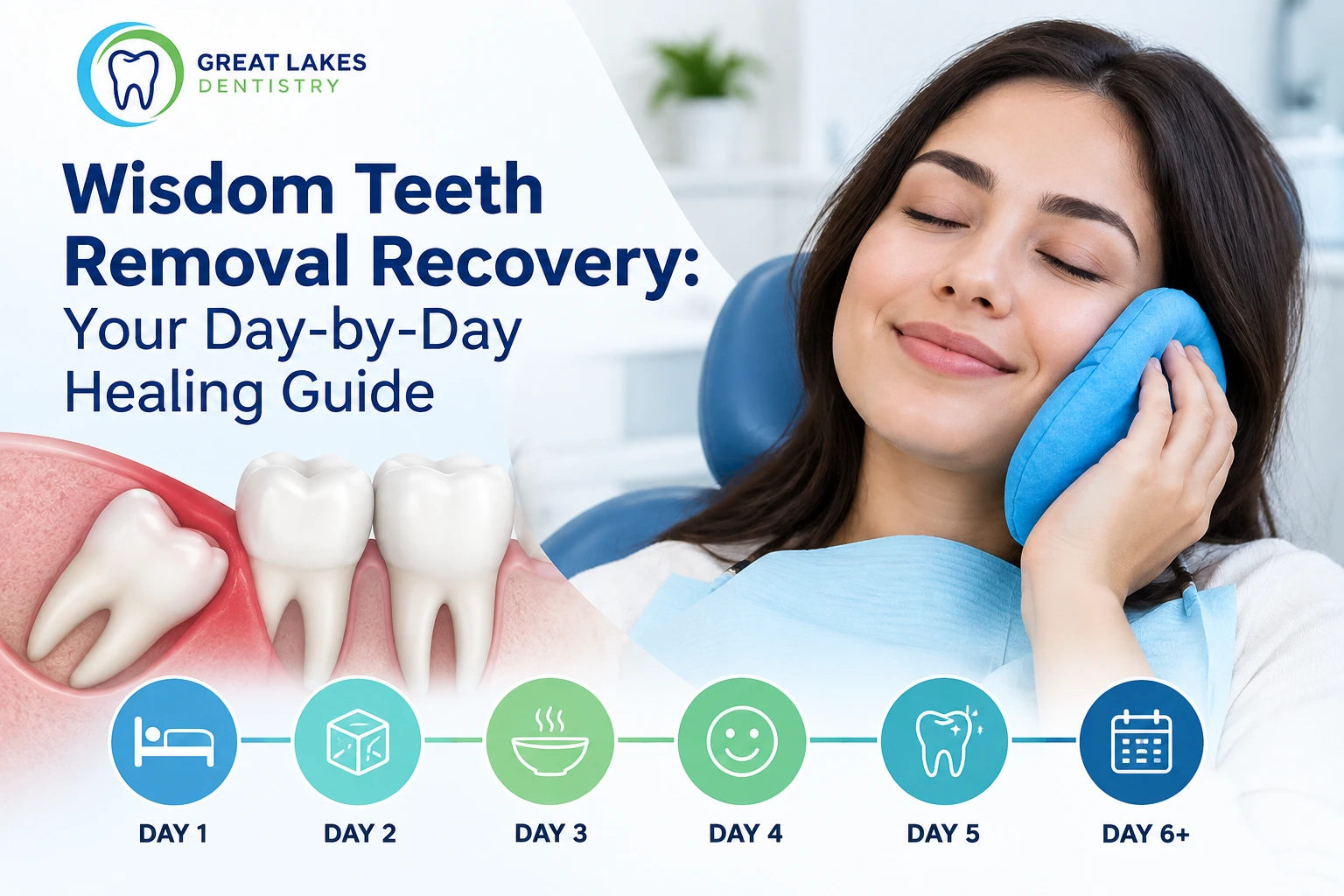
Knowing exactly what to expect at each stage of wisdom tooth recovery removes the anxiety and helps you heal faster
Wisdom Teeth Removal Recovery: Your Day-by-Day Healing Guide
Wisdom tooth removal is one of the most common oral surgical procedures — but for many patients, the recovery period feels uncertain and anxiety-inducing. What is normal swelling? When does the pain peak? When can you eat normally again? What does dry socket feel like and how do you avoid it? This complete day-by-day recovery guide answers all of these questions clearly, so you know exactly what to expect at every stage of healing after your wisdom tooth extraction — and what signs warrant a call to your dentist.
Before You Begin: What Affects Your Recovery Timeline
Not all wisdom tooth recoveries are identical. Several factors influence how quickly and smoothly you heal:
- Impaction type and surgical complexity — a partially impacted tooth requiring incision and bone removal takes longer to heal than a fully erupted tooth extracted with simple forceps
- Number of teeth removed — patients who have all four wisdom teeth removed simultaneously experience more swelling and discomfort than those with one or two teeth extracted
- Age — younger patients (late teens to mid-20s) with shorter roots and less dense bone consistently experience faster healing than older patients
- General health and medications — immune function, blood thinners, and conditions like diabetes affect healing rate and infection risk
- Tobacco use — smoking is the most significant modifiable risk factor for dry socket and delayed healing after wisdom tooth extraction
- How closely you follow post-operative instructions — compliance with diet, rest, and hygiene guidelines is the single biggest factor within the patient’s control
With that context, here is what most patients can expect day by day.
Wisdom Tooth Recovery: Day-by-Day Timeline
Day 1 — The Most Important Day
What to expect: Numbness fading over 2 to 4 hours, active bleeding settling, significant swelling beginning, mild to moderate pain emerging as anesthetic wears off.
The hours immediately after your extraction are the most critical for your recovery. The blood clot that forms in your extraction socket is the biological foundation of your entire healing process — it protects the underlying bone and nerve and provides the scaffold for new tissue to grow. Everything you do on Day 1 should be oriented around protecting that clot.
Do on Day 1:
- Bite down gently on the gauze pad provided and hold for 30 to 45 minutes to control bleeding. Replace with fresh gauze if bleeding continues
- Keep your head elevated — including when sleeping. Use an extra pillow to prevent blood pooling that increases bleeding and swelling
- Apply an ice pack to the outside of your cheek — 20 minutes on, 20 minutes off — for the first 24 hours to minimize swelling
- Take your prescribed pain medication before the anesthetic fully wears off — staying ahead of pain is far more effective than chasing it
- Eat only soft, cool foods — yogurt, applesauce, mashed potato, smoothies eaten with a spoon
- Stay hydrated with water — drink from a cup or glass, not a bottle with a narrow opening
Do not on Day 1:
- Use a straw — the suction can pull the blood clot from the socket, causing dry socket
- Rinse, spit forcefully, or gargle — any suction or pressure dislodges the clot
- Eat hard, hot, crunchy, or spicy foods
- Smoke or use any tobacco product — nicotine constricts blood vessels and dramatically increases dry socket risk
- Exercise or engage in strenuous activity — elevated heart rate increases bleeding
Day 2 — Swelling Peaks
What to expect: Swelling reaches its maximum around 48 hours after surgery. This is normal and expected — even alarming-looking swelling is part of the body’s inflammatory healing response.
Bruising may begin to appear on the cheek, jaw, or neck — often a yellowish or purplish discolouration. This is also normal and will fade over the following week. Jaw stiffness (trismus) is common and typically peaks around day 2 to 3.
Switch from ice to warm compresses after the first 24 hours — warmth increases blood flow to the area and helps reduce residual swelling from this point onward.
Continue soft foods and liquid diet. Gentle warm saltwater rinses (half a teaspoon of salt in a glass of warm water) can begin after the first 24 hours — rinse gently without swishing.
Day 3 — The Turning Point
What to expect: Swelling begins to subside. Pain typically starts to decrease meaningfully from day 3 onward in straightforward cases.
Day 3 is the day many patients start to feel significantly better — and also the day dry socket most commonly develops if it is going to occur. Dry socket (alveolar osteitis) happens when the blood clot is dislodged or dissolves prematurely, leaving the underlying bone and nerve exposed. The hallmark sign is a sudden onset of severe, throbbing pain starting around day 2 to 4 — often radiating to the ear or jaw — that worsens rather than improves.
Dry socket warning signs:
- Worsening pain starting 2 to 4 days after extraction (not improving)
- Pain radiating to the ear, temple, or jaw
- A visible empty socket — the clot appears absent or the bone is visible
- Foul taste or odour from the socket that does not respond to rinsing
If you suspect dry socket, contact Great Lakes Dentistry immediately. It is treated in-office and typically resolves within days of appropriate care.
Days 4 and 5 — Noticeable Improvement
What to expect: Most patients report a meaningful reduction in pain and swelling. Jaw stiffness gradually eases. Many patients can reduce reliance on prescription pain medication and transition to over-the-counter ibuprofen as needed.
Soft foods can begin to expand — well-cooked pasta, scrambled eggs, soft fish, oatmeal, and mashed avocado are all appropriate. Continue avoiding anything hard, crunchy, sticky, or small-grained (rice, seeds, popcorn) that could lodge in the healing socket.
Continue gentle saltwater rinses after each meal to keep the socket area clean without disrupting healing tissue.
Day 7 — The One-Week Mark
What to expect: Significant improvement in all symptoms. Most visible swelling and bruising has resolved or is resolving. The socket is beginning to close visibly at the surface.
If you had non-dissolvable sutures placed, they are typically removed at a follow-up appointment around this time. The socket will still have an open indentation — this is normal. Complete surface closure of the gum tissue takes 2 to 4 weeks, while the underlying bone takes significantly longer to fully remodel.
Many patients feel ready to return to a near-normal diet by day 7 for simple extractions. Surgical extractions of impacted wisdom teeth typically require the soft-food diet to continue until day 10 to 14.
Week 2 — Returning to Normal
What to expect: Most patients with straightforward extractions are fully back to their normal diet and activities by the end of week 2. Soft tissue in the socket is healing well. Any remaining jaw stiffness continues to resolve.
You may notice white or yellowish tissue forming in the socket during this period — this is granulation tissue, a normal part of healing. It should not be mistaken for infection or pus.
Avoid strenuous exercise, heavy lifting, or contact sports until your dentist clears you — typically at the one-week to two-week mark depending on extraction complexity.
Weeks 3 to 4 — Soft Tissue Healed
What to expect: Gum tissue closes over the socket completely for most patients. The surface looks and feels like normal gum tissue. The area may still be slightly tender to deep pressure but should not be actively painful.
Months 2 to 6 — Bone Remodeling
What to expect: While you feel fully recovered on the surface, the jawbone is still gradually filling in the extraction socket through new bone formation. This process continues for 3 to 6 months and is completely silent and painless in healthy patients.
What to Eat During Wisdom Tooth Recovery
Days 1 to 3 — Liquid and Soft
Plain yogurt, applesauce, smoothies eaten with a spoon, mashed potato, cool broth (sipped not slurped), scrambled eggs, pudding, mashed banana, avocado. Keep everything cool or room temperature — avoid hot foods entirely in the first 24 hours.
Days 4 to 14 — Soft Solids
Soft-cooked pasta with mild sauce, flaky baked fish, oatmeal, well-cooked lentils or soup, soft bread (no crusts), mashed sweet potato, soft cheese. Avoid: seeds, nuts, popcorn, chips, hard bread, chewy meats, sticky foods, raw vegetables, and carbonated drinks.
Warning Signs That Require a Call to Your Dentist
Most recoveries proceed without complication — but contact Great Lakes Dentistry promptly if you notice:
- Dry socket — worsening pain from day 2 to 4, radiating to the ear or jaw, with an empty or foul-smelling socket
- Signs of infection — fever above 38°C, increasing swelling after day 3, pus or foul discharge, swollen lymph nodes in the neck
- Uncontrolled bleeding — persistent bleeding beyond the first few hours that does not slow with gauze pressure
- Persistent numbness beyond 24 hours — may indicate nerve involvement and warrants prompt assessment
- Difficulty swallowing or breathing — seek emergency care immediately
How to Speed Up Wisdom Tooth Recovery
Within the factors you can control, these habits consistently support faster, smoother healing:
- Do not smoke — even one cigarette significantly increases dry socket risk and delays tissue healing
- Rest adequately for the first 2 to 3 days — activity raises heart rate and blood pressure, which increases bleeding and swelling
- Stay well-hydrated — adequate fluid intake supports circulation and immune function
- Eat consistently — skipping meals deprives healing tissue of the protein and nutrients it needs
- Follow the saltwater rinse protocol — gentle rinsing after meals from day 2 onward keeps the socket clean and reduces bacterial contamination
- Complete your full antibiotic course if one was prescribed — stopping early is a common cause of post-surgical infection
According to the Canadian Dental Association, consistent post-operative care following oral surgery significantly reduces complication rates and supports complete, timely healing for the vast majority of patients.
Trusted Resources on Oral Surgery Recovery
- Canadian Dental Association — Oral Health Resources
- Health Canada — Dental Care Guidelines
- World Health Organization — Oral Health Facts
Questions About Your Wisdom Tooth Recovery in Oakville?
The team at Great Lakes Dentistry is here for you at every stage of your healing. Call Dr. Gurpreet Mohi and our team at (905) 825-1212 or book online — we provide post-operative support for all our wisdom tooth extraction patients.
Frequently Asked Questions: Wisdom Tooth Recovery
How long does wisdom tooth recovery take?
Soft tissue healing is typically complete within 2 to 4 weeks. Most patients feel back to normal daily activities within 3 to 5 days and return to a near-normal diet by day 7 to 14, depending on extraction complexity. Full bone remodeling of the socket takes 3 to 6 months, though this is entirely silent and pain-free in healthy patients. Surgical extraction of impacted wisdom teeth requires a longer recovery than simple removal of erupted teeth.
When does wisdom tooth pain peak?
Pain and swelling typically peak around 48 to 72 hours after surgery — days 2 and 3. Most patients experience meaningful improvement in pain from day 3 or 4 onward. If pain is worsening rather than improving after day 3, particularly if it is severe and radiates to the ear or jaw, dry socket or infection should be assessed by your dentist promptly.
What is dry socket and how common is it?
Dry socket (alveolar osteitis) occurs when the blood clot protecting the extraction socket is dislodged or dissolves prematurely, exposing the underlying bone and nerve. It produces severe, worsening pain typically beginning 2 to 4 days after extraction, often radiating to the ear. Dry socket affects approximately 2 to 5 percent of routine extractions and up to 20 percent of impacted lower wisdom tooth removals. Risk increases significantly with smoking. It is treatable in-office and resolves quickly with appropriate care.
When can I eat normally after wisdom tooth removal?
Most patients can gradually return to a normal diet by day 7 to 10 for simple extractions, and by day 10 to 14 for surgical removal of impacted wisdom teeth. The key milestones are: soft liquids only on day 1; soft solids from day 3 onward; most foods by week 2. Foods to continue avoiding throughout recovery include seeds, nuts, popcorn, chips, hard bread, sticky foods, and carbonated beverages that could disturb the healing socket.
Is it normal to have swelling for a week after wisdom tooth extraction?
Yes — swelling after wisdom tooth extraction, particularly surgical removal of impacted teeth, can persist for 5 to 7 days. Swelling peaks around day 2 to 3 and then gradually subsides. Bruising of the cheek and jaw area is also normal and typically resolves within 7 to 10 days. Swelling that continues to increase after day 3 rather than improving warrants a call to your dentist, as it may indicate infection.
Can I brush my teeth after wisdom tooth removal?
Yes — but carefully. Brush your other teeth normally from day 1 onward to maintain oral hygiene. Avoid brushing directly over the extraction site for the first few days. From day 2 onward, use gentle warm saltwater rinses after meals to keep the socket area clean. A water flosser on a low setting can be used carefully around other teeth from approximately day 7 onward, keeping the tip away from the extraction site.
When can I return to exercise after wisdom tooth removal?
Light activity such as short walks can typically resume from day 3 or 4 onward. Strenuous exercise, heavy lifting, and contact sports should be avoided for a minimum of 1 week — and up to 2 weeks for surgical extractions. Elevated heart rate and blood pressure during exercise increase bleeding risk and can disrupt the healing clot. Your dentist will confirm the appropriate timeline at your post-operative follow-up.
What does normal healing look like in the wisdom tooth socket?
In the first 24 hours, a dark red or maroon blood clot forms in the socket. By days 3 to 5, the clot may appear white or yellowish — this is granulation tissue forming and is completely normal. The socket visibly shallows week by week as gum tissue grows over it from the edges inward. Full surface closure typically takes 2 to 4 weeks. Any socket that appears empty, has visible bone, or produces a foul odour should be assessed for dry socket.
Final Thoughts
Key Takeaways: Wisdom Tooth Removal Recovery
- Day 1 is the most critical — protect the blood clot by avoiding straws, spitting, smoking, and strenuous activity
- Swelling and pain peak at days 2 to 3 and should improve meaningfully from day 3 or 4 onward
- Dry socket — worsening pain from day 2 to 4 — is treatable but requires prompt in-office care
- Soft tissue healing completes in 2 to 4 weeks; bone remodeling takes 3 to 6 months
- Not smoking is the single most impactful choice for a complication-free recovery
- When in doubt, call Great Lakes Dentistry at (905) 825-1212 — our team is here for you throughout your recovery