
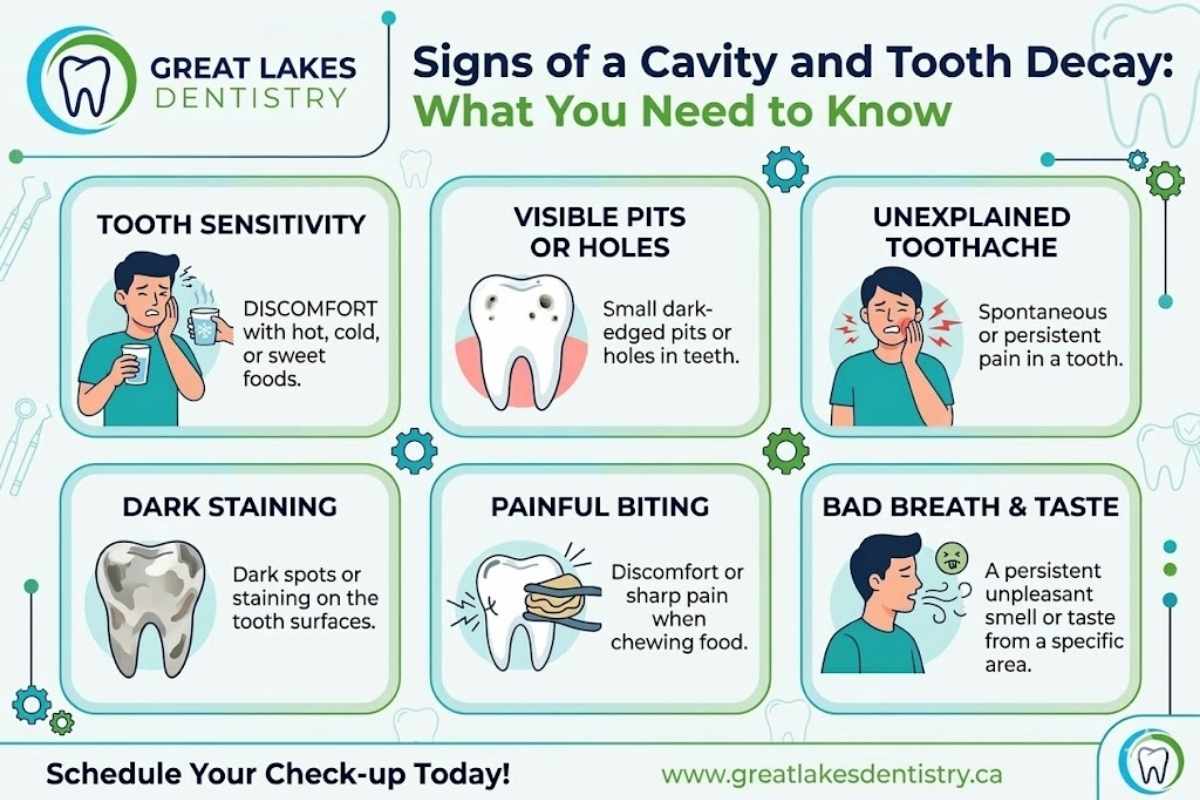
Recognizing early cavity signs can prevent serious dental problems
Signs of a Cavity and Tooth Decay: What You Need to Know
Tooth decay is one of the most common dental conditions affecting Canadians of all ages. Understanding the signs of a cavity early gives you the best chance of treating it simply, quickly, and affordably — before the damage progresses.
What Is a Cavity?
A cavity is permanent damage to a tooth — a small hole or eroded area that forms when bacterial acids break down the hard outer surface of the enamel over time. Bacteria in your mouth feed on sugars and produce acids that strip minerals from enamel in a process called demineralization. If this happens repeatedly without adequate brushing, fluoride, or saliva neutralization, the enamel weakens and eventually breaks down — forming a cavity.
Left untreated, a cavity deepens through the enamel into the dentin and eventually into the pulp, where the tooth’s nerves and blood vessels live. According to the Canadian Dental Association, untreated tooth decay can lead to infection, severe pain, and tooth loss if not addressed early.
Key Understanding
Once a physical cavity forms in the enamel, it cannot heal on its own. Professional treatment is required to stop the decay from progressing.
What Does a Cavity Look Like?
Cavities look different depending on the tooth affected and how far the decay has progressed. Many people expect a visible hole — but in most cases, early decay is invisible to the naked eye.
Very Early Stage — Pre-Cavity (White Spot)
- Chalky white patch on the enamel surface
- Dull or matte appearance compared to surrounding enamel
- No physical hole yet — this stage may still be reversible
- Mild sensitivity to cold or sweet foods
Early to Moderate Cavity
- White spot darkens to yellow, light brown, or grey
- Small pit or rough texture felt with the tongue
- Visible brown or black stain on the tooth surface
- Sensitivity to temperature and sweets becomes more noticeable
Advanced Cavity
- Clearly visible hole or crater in the tooth
- Dark brown or black discoloration covering a larger area
- Crumbling or structurally weakened enamel
- Persistent or spontaneous tooth pain
- Possible swelling or abscess near the affected tooth
Interproximal cavities — those that form between teeth — are almost never visible without dental X-rays. This is one of the most important reasons to attend regular professional teeth cleanings and checkups at least twice per year.
Signs of a Cavity: 8 Symptoms to Watch For
The signs and symptoms of a cavity vary depending on how advanced the decay is. Here are the eight most important warning signs.
1. Tooth Sensitivity to Hot, Cold, or Sweet
Sensitivity is often the first symptom patients notice. When enamel is compromised, the dentin beneath becomes exposed. Dentin contains microscopic tubules connected to the nerve, making the tooth hypersensitive to temperature and sugar. A brief, sharp sensation when drinking cold water or eating ice cream is a classic early cavity symptom.
2. Lingering or Spontaneous Toothache
Pain that persists for more than a few seconds after a stimulus — or pain that appears without any obvious trigger — suggests the decay has reached deeper layers of the tooth. This symptom should not be ignored.
3. Visible Holes, Pits, or Dark Spots
A hole or pit you can feel with your tongue, or a brown or black discoloration on the chewing surface of a tooth, is a direct visual sign of cavity tooth decay. Dark spots that do not wipe away are often the result of bacterial staining from long-standing enamel damage.
4. Pain or Discomfort When Biting
If chewing on a particular tooth produces a sharp pain or dull ache, the structural integrity of that tooth has likely been compromised by decay.
5. Persistent Bad Breath or Sour Taste
The bacteria responsible for tooth decay produce volatile compounds as they break down tooth structure and food debris. Persistent bad breath or an unexplained bad taste — even after brushing — can indicate active decay somewhere in the mouth.
6. Food Consistently Getting Trapped in One Spot
If food regularly gets stuck in the same area between teeth or in a specific groove, this can indicate a physical cavity or breakdown in the tooth surface. Increased plaque accumulation in that area accelerates the decay further.
7. Visible Swelling or Gum Changes Near a Tooth
Redness, puffiness, or a small raised bump on the gum near a tooth can indicate that infection from deep decay has begun spreading to surrounding tissue. This is a sign of a dental abscess. Emergency dental care in Oakville should be sought without delay if you notice swelling alongside tooth pain.
8. White Spots on Enamel
Chalky white patches are not cavities yet — but they are a direct warning sign of active demineralization. At this stage, fluoride treatment can halt and sometimes reverse the process before a cavity forms.
Caries Signs and Symptoms by Stage
Dental professionals use the term dental caries to describe the disease process that causes cavities. The caries signs and symptoms progress through defined stages:
Stage 1 — White Spot Lesion
Enamel demineralization is underway. No structural damage yet. Potentially reversible with fluoride and dietary changes.
Stage 2 — Enamel Cavity
The enamel surface has broken down. A small cavity is present. Requires a dental filling to halt progression.
Stage 3 — Dentin Involvement
Decay has reached the dentin. Sensitivity becomes pronounced. A filling or inlay is typically required.
Stage 4 — Pulp Involvement
Bacteria have reached the nerve. Severe pain and possible abscess. Root canal treatment is usually necessary.
What Causes Tooth Decay?
Several factors work together over time to cause cavities. Understanding them helps explain why certain people develop decay more frequently than others.
- Bacterial plaque: A sticky biofilm of bacteria forms continuously on teeth. When not removed, plaque bacteria metabolize sugars and produce enamel-eroding acids.
- Frequent sugar consumption: Every time you consume sugar or refined carbohydrates, plaque bacteria produce an acid attack lasting approximately 20 to 30 minutes. Frequent snacking means near-constant acid exposure.
- Poor oral hygiene: Infrequent or ineffective brushing and flossing allows plaque to accumulate and cause greater enamel damage over time.
- Dry mouth: Saliva neutralizes plaque acids and remineralizes enamel. Reduced saliva flow — from medications, health conditions, or mouth breathing — leaves teeth more vulnerable.
- Lack of fluoride: Fluoride strengthens enamel and supports remineralization. Individuals who do not use fluoride toothpaste consistently face a higher cavity risk.
- Infrequent dental visits: Skipping professional teeth cleanings allows tartar buildup that cannot be removed by brushing alone.
The Government of Canada’s oral health guidelines identify these same risk factors and recommend fluoride toothpaste and regular dental visits as the cornerstone of cavity prevention.
How Dentists Diagnose Cavities
Not all cavities are visible. Dentists use a combination of methods to find decay at every stage:
- Visual and tactile examination: The dentist inspects each tooth and uses a dental probe to check for soft spots or breaks in the enamel surface.
- Dental X-rays: Bitewing X-rays detect interproximal cavities invisible during a visual exam and reveal how deep existing decay has progressed.
- Symptom history: The dentist asks about sensitivity, pain location, duration, and triggers to identify which teeth require closer attention.
Early diagnosis consistently leads to simpler, less invasive, and less costly treatment. Patients in Oakville can have a thorough cavity assessment at Great Lakes Dentistry.
Treatment Options for Cavity Tooth Decay
The right treatment depends entirely on how far decay has progressed at the time of diagnosis.
Fluoride Treatment
For very early-stage white spot lesions that have not yet broken through the enamel, professional fluoride application can halt demineralization and support remineralization. Only effective before a physical cavity has formed.
Dental Fillings
The standard treatment for cavities that have broken through the enamel. Decayed material is removed and the tooth is restored with composite resin or another appropriate material.
Dental Crowns
When decay has destroyed a significant portion of the tooth, a crown restores full function and protects remaining tooth structure. Dental crowns in Oakville at Great Lakes Dentistry are matched to natural tooth colour and designed for long-term durability.
Root Canal Treatment
When decay has reached the pulp chamber, root canal treatment removes the infected nerve tissue, cleans and seals the canals, and saves the tooth from extraction. Learn more about root canal treatment at Great Lakes Dentistry.
Tooth Extraction
In cases where the tooth is too compromised to restore, extraction is necessary. The Canadian Dental Association outlines when extraction becomes the appropriate course of action. Replacement options such as dental implants or dental bridges can restore function and appearance afterward.
How Long Does a Cavity Filling Take?
- Small cavity: 20–40 minutes
- Moderate cavity: 30–60 minutes
- Multiple fillings: Longer appointment — discuss with your dentist in advance
Recovery After a Filling
- Temporary numbness immediately after treatment
- Mild sensitivity for a few days — normal and expected
- Bite should normalize within a week
- Contact your dentist if pain or sensitivity worsens after a week
What Happens If a Cavity Is Left Untreated?
- Decay spreads deeper into dentin and pulp
- Severe, spontaneous toothache develops
- Dental infection or abscess may form
- Root canal therapy becomes necessary
- In advanced cases, tooth loss is the outcome
- Severe throbbing pain
- Facial or gum swelling
- Fever alongside tooth pain
- Pus or a foul taste in the mouth
- Pain severe enough to disrupt sleep
These are signs of a dental emergency. Contact the emergency dentist at Great Lakes Dentistry in Oakville immediately.
How to Prevent Cavities
Cavity prevention is straightforward and well-supported by evidence. These habits form the foundation of a decay-free mouth:
- Brush twice daily with fluoride toothpaste for at least two minutes, covering all tooth surfaces including the gum line
- Floss daily to remove plaque and food from between teeth where toothbrush bristles cannot reach
- Reduce sugar frequency — it is not just the quantity of sugar but how often teeth are exposed that causes the most damage
- Drink water after meals to rinse away food debris, dilute acids, and support saliva production
- Attend regular checkups and cleanings — professional teeth cleanings remove tartar that brushing cannot and allow early decay detection
- Start children early — children’s dentistry at Great Lakes Dentistry includes sealants and fluoride varnish that dramatically reduce cavity risk
Concerned About a Possible Cavity?
Early evaluation can prevent pain, protect your teeth, and keep treatment simple. The team at Great Lakes Dentistry in Oakville is ready to help.
Book Appointment
Understanding Coverage and Patient Support
Canada Dental Care Plan (CDCP)
The Canadian Dental Care Plan (CDCP) provides eligible Canadians with coverage for diagnostic, preventive, and restorative dental treatments including fillings. If cost is a barrier to care, check your eligibility through Health Canada or speak to our office directly.
Health Information Resources
For reliable, evidence-based oral health guidance:
Expert Dental Care in Oakville
At Great Lakes Dentistry, patients receive comprehensive cavity evaluations, digital X-ray diagnostics, and minimally invasive restorative treatments tailored to each individual. Whether you need a routine checkup or urgent care, the team is here for patients of all ages.
Frequently Asked Questions
What are the first signs of a cavity?
The earliest signs of a cavity are a chalky white spot on the enamel and mild sensitivity to cold or sweet foods. At this stage, the process may still be reversible with fluoride treatment and improved oral hygiene.
Can I see a cavity myself?
Sometimes. Visible dark spots, holes, or rough areas may be detectable, but many cavities — especially those forming between teeth — require dental X-rays for detection. A professional examination is the only reliable way to confirm a cavity.
Do cavities always hurt?
No. Early decay often develops without any pain. By the time a cavity causes significant discomfort, it has usually progressed well beyond its earliest stage. This is why regular dental checkups are so important.
Can brushing fix a cavity?
Brushing helps prevent cavities from forming and can halt very early enamel lesions when combined with fluoride, but once a physical cavity has developed, professional treatment is required. Brushing alone cannot reverse structural damage to the tooth.
What happens if a cavity is left untreated?
Untreated decay progresses through the enamel and dentin into the pulp, causing infection, severe pain, and potentially an abscess. In advanced cases, the tooth may require root canal treatment or extraction. Early treatment with a simple filling prevents all of this.
How long does a cavity filling take?
Most fillings take between 20 and 60 minutes depending on the size and location of the cavity. Small cavities are typically completed in a single short appointment.
Does the Canadian Dental Care Plan cover cavity fillings?
The Canadian Dental Care Plan (CDCP) covers eligible Canadians for restorative treatments including fillings. Check your eligibility through Health Canada or speak to your dental provider for coverage details.
How can I prevent cavities in my children?
Start dental visits early, limit sugary drinks and snacks, supervise brushing until around age eight, and ask your dentist about sealants and fluoride varnish. Children’s dentistry at Great Lakes Dentistry is designed to make early visits positive and preventive.
Final Thoughts
- Less invasive procedure — often just a simple filling
- Lower long-term treatment costs
- Significantly reduced discomfort
- Better long-term tooth preservation
Cavities are among the most preventable conditions in dentistry — yet they remain among the most common, precisely because the early warning signs are so easy to overlook. A chalky white spot, brief cold sensitivity, or food trapping in the same spot every time are not minor inconveniences. They are your teeth telling you something needs attention.
The earlier that message is acted on, the simpler and less invasive the treatment will be. A cavity caught at the white spot stage may need nothing more than a fluoride application. The same cavity left for another year may need a crown. Left another year beyond that — a root canal or extraction.
Good oral hygiene, a tooth-friendly diet, regular professional cleanings, and consistent dental checkups are not complicated commitments. They are the four habits that keep a simple problem from becoming an expensive and painful one.
If you have noticed any of the signs covered in this guide, do not wait for the pain to get worse. The right next step is a professional evaluation. The team at Great Lakes Dentistry in Oakville is here to help — whether you need a routine checkup, a cavity assessment, or urgent care. Book your appointment today or call (905) 825-1212.