
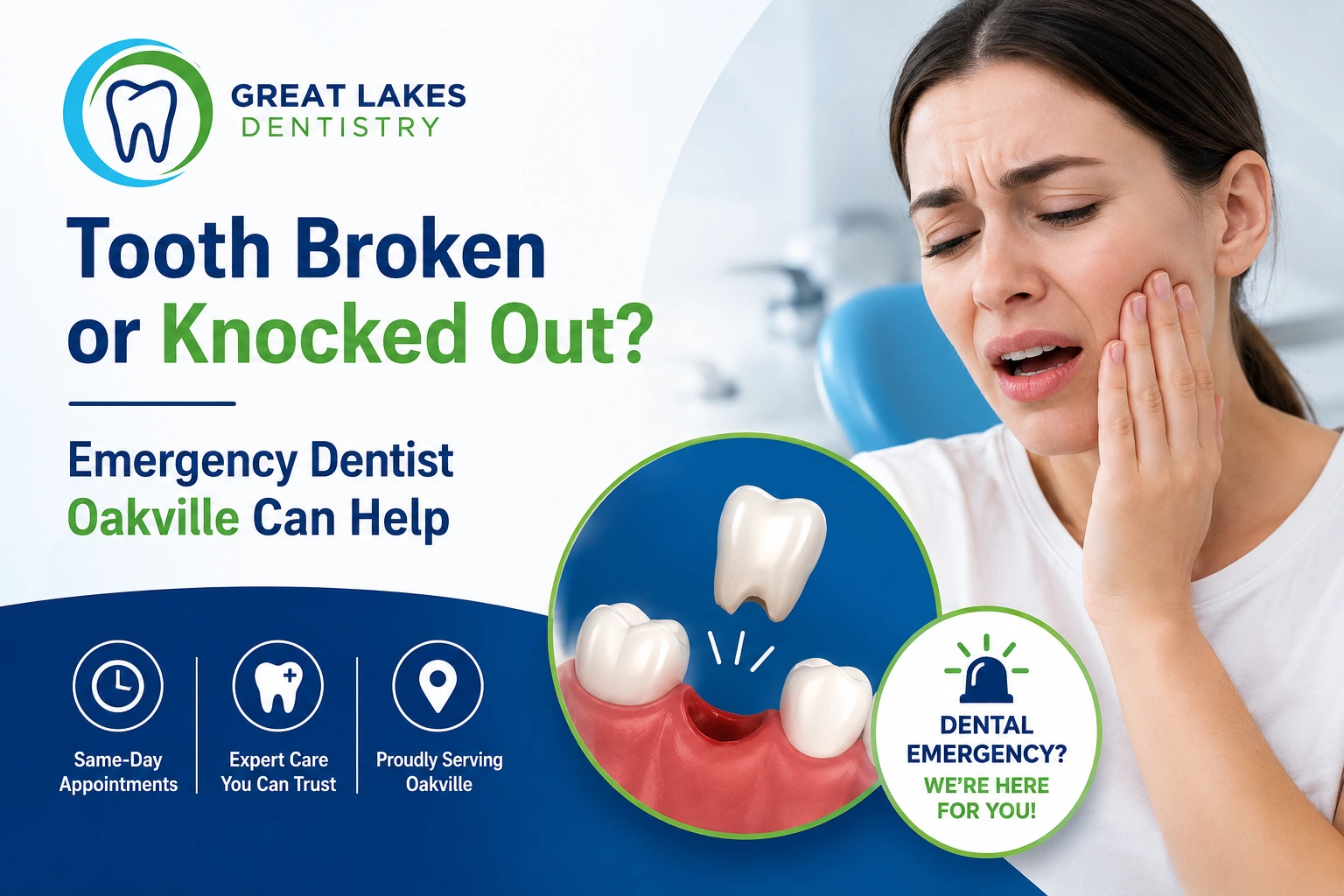
A broken or knocked-out tooth is a true dental emergency — how you respond in the first 30 minutes can determine whether the tooth is saved
Tooth Broken or Knocked Out? Emergency Dentist Oakville Can Help
A broken or knocked-out tooth is one of the most stressful dental situations a person can face — and it almost always happens without warning. Whether it happened during a sports game, a fall, biting down on something hard, or an accident, the actions you take in the first 30 minutes are the single biggest factor in whether the tooth can be saved. If you are in Oakville and facing a dental emergency right now, this guide tells you exactly what to do — and how Dr. Gurpreet Mohi at Great Lakes Dentistry can help.
Broken Tooth vs. Knocked-Out Tooth — Understanding the Difference
While both are dental emergencies requiring prompt professional care, a broken tooth and a knocked-out tooth are clinically different situations that require different first-response actions.
A broken or chipped tooth occurs when a portion of the visible tooth fractures — ranging from a minor corner chip to a severe split that involves the root. The tooth remains in the socket but is structurally compromised. Pain ranges from minimal (a small chip) to severe (fracture reaching the nerve).
A knocked-out tooth — clinically called a dental avulsion — is the complete displacement of the tooth from its socket. This is the most time-critical dental emergency in dentistry. The tooth’s periodontal ligament fibres must remain alive for reimplantation to succeed, and those fibres begin dying within minutes outside the socket.
Both situations require same-day dental care. The key difference is urgency: a knocked-out tooth must be treated within 30 to 60 minutes for the best chance of reimplantation. A broken tooth, while urgent, typically allows slightly more time to seek care.
What to Do If Your Tooth Is Knocked Out
If a permanent tooth has been completely knocked out, the next 30 minutes are critical. Follow these steps precisely while getting to your dentist as fast as possible:
Step 1 — Find and Handle the Tooth Correctly
Pick up the tooth immediately. Hold it by the crown (the white chewing surface) only — never touch the root. The root is covered in periodontal ligament cells that must remain intact for reimplantation to work. Touching, scrubbing, or drying the root destroys these cells irreversibly.
Step 2 — Rinse If Needed, But Do Not Scrub
If the tooth is visibly dirty, rinse it very gently with milk or sterile saline. If neither is available, use clean water for a brief rinse only. Do not use soap, do not scrub the root surface, and do not wrap the tooth in a dry tissue or cloth — drying the root is as damaging as scrubbing it.
Step 3 — Reinsert the Tooth If Possible
The ideal storage location for a knocked-out tooth is back in its socket. If you are conscious, calm, and able to do so safely — gently push the tooth back into the socket in the correct orientation and hold it in place by biting softly on a clean cloth or gauze. This keeps the periodontal ligament cells alive in the best possible environment.
Step 4 — If Reinsertion Is Not Possible, Store Correctly
If reinsertion is not possible — for example, if the patient is a child, is in shock, or there is significant bleeding — store the tooth in one of the following in order of preference:
- Milk — the best and most accessible storage medium. Osmotically compatible with the periodontal ligament cells
- Saline solution — acceptable second option
- Between the cheek and gum — saliva keeps the cells alive if other options are unavailable. Do not use this option for young children who may swallow the tooth
- Plain water — last resort only; osmotic differences cause cell death within 20 minutes, but it is better than letting the tooth dry out entirely
Never store a knocked-out tooth in a dry tissue, paper towel, or open air. Drying destroys the periodontal fibres within minutes and makes reimplantation impossible regardless of how quickly you reach the dentist.
Step 5 — Get to Your Oakville Emergency Dentist Immediately
Call Great Lakes Dentistry at (905) 825-1212 while someone else drives you to our Oakville clinic. Let us know a tooth has been knocked out so we can prepare for your arrival. Time from tooth loss to reimplantation is the single most important factor in success — outcomes are significantly better within 30 minutes and drop sharply after 60 minutes.
What to Do If Your Tooth Is Broken or Chipped
A broken tooth ranges from a minor cosmetic chip to a severe fracture involving the nerve or root. Here is how to respond at home before your emergency appointment:
- Rinse your mouth with warm water to clear debris and reduce bacterial exposure to the fracture site
- Apply a cold compress to the outside of the cheek or lip to manage swelling — 20 minutes on, 20 minutes off
- Save any broken fragments — bring them to your appointment. In some cases they can be bonded back in place
- Cover sharp edges with dental wax (available at most pharmacies) if the broken edge is cutting your tongue or cheek
- Avoid chewing on the affected side and keep very hot, cold, or sweet foods away from the broken tooth
- Take ibuprofen as directed for pain — it also reduces inflammation around the fracture site
Do not delay seeing a dentist, even if the break appears minor. A crack that reaches the dentin or pulp chamber will worsen — and a fracture that extends into the root may not be saveable if left too long.
How Does an Emergency Dentist Treat a Broken Tooth?
Treatment for a broken tooth depends entirely on the severity and location of the fracture. At Great Lakes Dentistry, Dr. Mohi will assess your tooth using digital X-rays and clinical examination before recommending the most appropriate treatment:
Minor Chips and Small Fractures
Small chips that affect only the enamel are often treated with dental bonding — a tooth-coloured composite resin applied and shaped to restore the tooth’s appearance and smooth the broken edge. This is typically completed in a single appointment.
Moderate Fractures Involving Dentin
When the fracture reaches the dentin layer beneath the enamel, a dental crown is typically the most appropriate restoration. A crown covers and protects the remaining tooth structure, preventing further fracture and restoring full function and appearance.
Fractures Involving the Pulp (Nerve)
If the fracture has exposed or compromised the tooth’s pulp — producing spontaneous pain, severe sensitivity, or visible pink tissue — root canal treatment is needed to remove the infected or exposed nerve tissue before the tooth can be restored. A crown is placed afterward to protect the treated tooth.
Vertical Root Fractures
Fractures that run vertically down the root — often producing vague, intermittent symptoms for months — are among the most difficult to treat. In many cases the tooth cannot be saved and extraction is the only option, followed by tooth replacement planning.
How Does an Emergency Dentist Treat a Knocked-Out Tooth?
If you arrive at Great Lakes Dentistry with the tooth stored correctly and within the critical window, Dr. Mohi will:
- Examine the socket for debris, contamination, and bone integrity
- Gently irrigate the socket with saline
- Carefully reinsert the tooth into the socket in correct alignment
- Splint the reimplanted tooth to adjacent teeth using a flexible wire and composite — this holds the tooth stable while the socket heals over 2 to 6 weeks
- Take X-rays to confirm positioning
- Prescribe antibiotics and pain management as appropriate
- Schedule close follow-up appointments to monitor healing and root resorption
Root canal treatment is almost always required for a reimplanted adult tooth — the nerve and blood supply cannot typically survive avulsion, but the root structure can survive and the tooth can remain functional for years with proper care.
If the tooth cannot be reimplanted — due to time elapsed, root damage, or patient factors — Great Lakes Dentistry will begin tooth replacement planning immediately, including discussion of dental implants as the gold standard for permanent tooth replacement.
Why Timing Is Everything in Dental Emergencies
The relationship between time and outcome in dental emergencies is direct and well-documented. For a knocked-out tooth:
- Under 30 minutes — highest success rates for reimplantation when stored correctly
- 30 to 60 minutes — still possible with good storage; success rates decline
- Over 60 minutes — reimplantation is significantly less likely to succeed; periodontal ligament cell viability is greatly reduced
- Over 2 hours (dry) — reimplantation for functional retention is typically not attempted; the tooth may be reimplanted for cosmetic or developmental reasons in young patients only
For broken teeth, delays increase the risk of nerve exposure, infection, and structural progression of the fracture — turning a restorable tooth into one that requires extraction.
Prompt action is always the right response to a dental emergency. Great Lakes Dentistry’s emergency dental team in Oakville prioritizes emergency patients to minimize wait time from injury to treatment.
Preventing Broken and Knocked-Out Teeth
While accidents are never fully predictable, many of the most common causes of broken and knocked-out teeth are preventable:
- Wear a custom mouthguard during all contact and collision sports — rugby, hockey, football, basketball, martial arts, and cycling all carry significant tooth-injury risk. Custom mouthguards from your dentist offer far superior protection to over-the-counter options
- Never use your teeth as tools — opening bottles, tearing packaging, and holding objects with your teeth are among the most common causes of preventable tooth fractures
- Address bruxism (teeth grinding) with a night guard — chronic grinding creates micro-fractures in tooth enamel that make teeth significantly more vulnerable to sudden fracture under normal biting forces
- Maintain regular checkups — existing large fillings, cracks, and structural weaknesses can be identified and protected before they result in emergency fractures
Our family dentistry team at Great Lakes Dentistry can fit custom sports mouthguards and night guards for patients of all ages — a straightforward preventive investment that can protect teeth for years.
What to Expect at Your Emergency Appointment
When you arrive at Great Lakes Dentistry for an emergency appointment, our team responds quickly and calmly:
- You are assessed as a priority — we do not send emergency patients to the waiting room to fill out forms while in pain
- Pain management is addressed immediately where possible
- Digital X-rays are taken to assess the fracture, root integrity, and surrounding bone
- Dr. Mohi explains exactly what has happened, what the treatment options are, and what each involves — before starting anything
- Where clinically appropriate, treatment is completed same-appointment
- A clear follow-up plan is established before you leave
For patients experiencing significant dental anxiety during their emergency visit, our sedation dentistry options are available to ensure the experience is as comfortable as possible — even under urgent circumstances.
Trusted Resources on Dental Emergency Care
- Canadian Dental Association — Oral Health Resources
- Health Canada — Dental Care Guidelines
- World Health Organization — Oral Health Facts
Tooth Broken or Knocked Out in Oakville? Call Us Now
Do not wait. Call Great Lakes Dentistry at (905) 825-1212 immediately. Dr. Gurpreet Mohi and our emergency dental team are ready to see you today — with the calm, expert care your smile deserves.
Frequently Asked Questions: Broken and Knocked-Out Teeth in Oakville
Can a knocked-out tooth be saved?
Yes — if you act quickly. A knocked-out permanent tooth can often be successfully reimplanted if it reaches an emergency dentist within 30 to 60 minutes, stored correctly in milk, saline, or the socket itself. The periodontal ligament cells on the root must remain alive for reimplantation to succeed, which is why storage medium and speed are both critical. Do not let the tooth dry out, and get to Great Lakes Dentistry in Oakville immediately.
What is the best way to store a knocked-out tooth?
The best option is to reinsert the tooth gently into its socket and hold it in place. If that is not possible, store it in cold milk — the most accessible and osmotically appropriate storage medium. Saline is the second-best option, followed by keeping it between the cheek and gum in saliva. Never store a knocked-out tooth in a dry cloth or tissue, and never let it dry out. Plain water is a last resort only.
What should I do if my tooth breaks but doesn’t hurt?
Still seek dental care promptly — even if there is no pain. A painless break may indicate the fracture has not yet reached the nerve, but cracks progress and deepen with normal biting forces. A fracture that is restorable with bonding or a crown today may require root canal treatment or extraction if left until symptoms develop. Save any broken fragments and call Great Lakes Dentistry for a same-day or next-day assessment.
How long does it take to treat a broken tooth?
Treatment time depends on the severity of the fracture. A minor chip treated with dental bonding can often be completed in 30 to 60 minutes in a single appointment. A crown requires an initial preparation appointment and a second fitting appointment, typically 1 to 2 weeks apart. If root canal treatment is needed first, treatment spans 2 to 3 appointments over several weeks. Dr. Mohi will give you an accurate timeline after assessing your specific fracture.
Does Great Lakes Dentistry accept emergency walk-in patients?
Yes. Great Lakes Dentistry in Oakville provides same-day emergency care for both existing and new patients. We strongly recommend calling ahead at (905) 825-1212 so our team can prepare for your arrival and minimize your wait time. For a knocked-out tooth especially, calling while en route allows us to be ready the moment you walk through the door.
What happens if a knocked-out tooth cannot be reimplanted?
If reimplantation is not possible — due to time elapsed, root damage, or other factors — tooth replacement planning begins immediately. Dental implants are the gold standard for replacing a single missing tooth, preserving jawbone density and providing a natural look and function. Dr. Mohi will outline all available replacement options at your appointment so you can make an informed decision on the best path forward.
Should I go to the emergency room for a broken tooth?
Hospital emergency rooms are appropriate for dental emergencies involving facial trauma, uncontrolled bleeding, airway concerns, or significant swelling affecting the neck or throat. For broken or knocked-out teeth without life-threatening complications, a dental practice — not a hospital ER — provides the definitive care needed. ERs can offer pain relief and antibiotics but cannot perform the dental procedures (bonding, crowns, reimplantation) required to save the tooth.
Can children get dental implants after losing a tooth?
Dental implants are not placed in children or teenagers whose jaw growth is still incomplete, as the implant could become mispositioned as the jaw develops. Children who lose a permanent tooth due to trauma typically receive a space maintainer to hold the gap while the jaw matures. Implant placement is reconsidered once jaw growth is complete — usually in the late teens or early adulthood. Dr. Mohi will advise on the most appropriate interim and long-term management for your child’s specific situation.
Final Thoughts
Key Takeaways: Broken or Knocked-Out Tooth in Oakville
- A knocked-out tooth must reach an emergency dentist within 30 minutes for the best chance of reimplantation — every minute counts
- Store a knocked-out tooth in milk, saline, or the socket — never in a dry tissue or open air
- Pick up a knocked-out tooth by the crown only — never touch the root surface
- A broken tooth without pain still requires prompt dental care — cracks always progress
- Treatment ranges from same-day bonding to crown or root canal depending on fracture severity
- Great Lakes Dentistry in Oakville provides same-day emergency care — call (905) 825-1212 immediately