
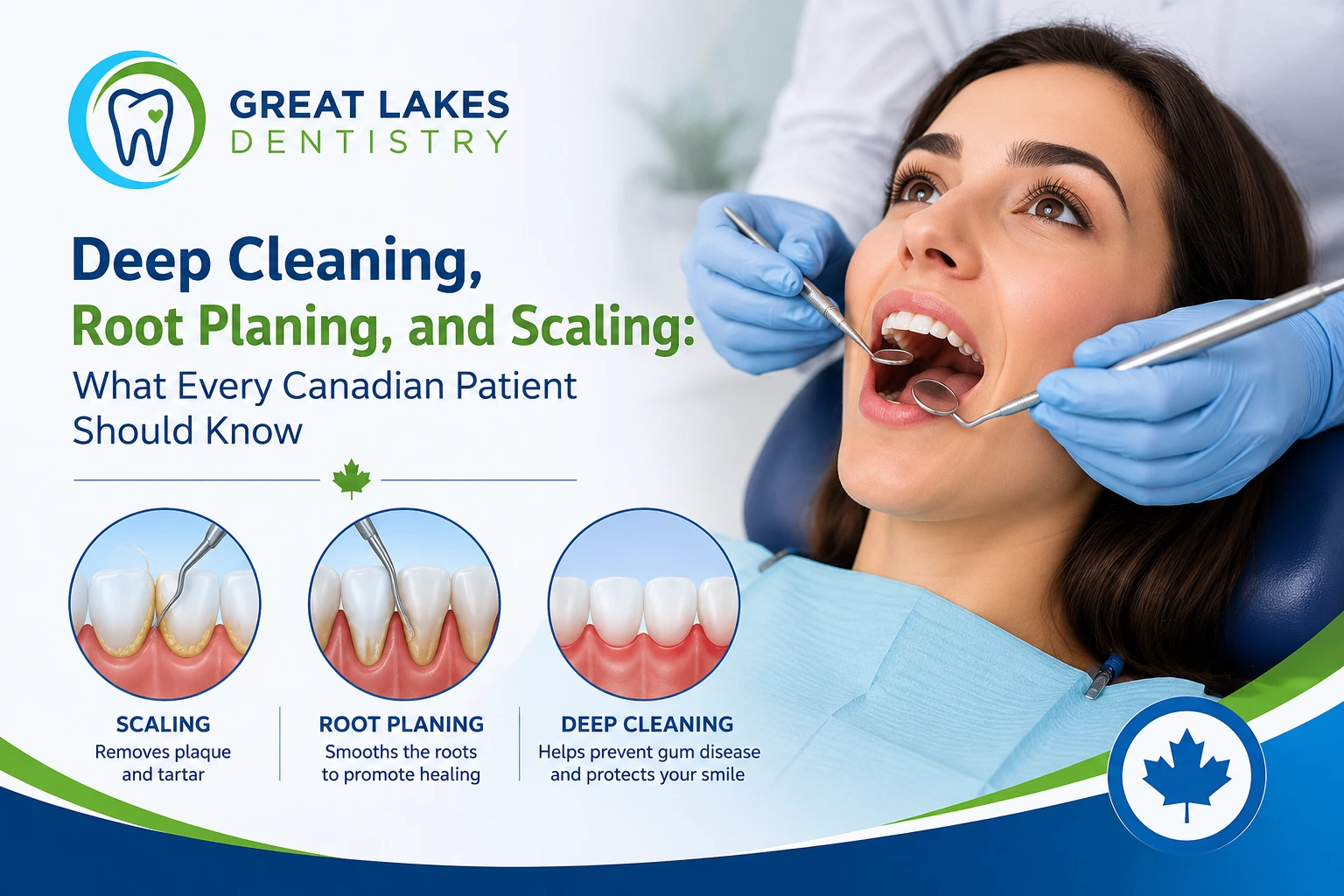
Scaling and root planing is the most effective non-surgical treatment for gum disease — and understanding the procedure removes the anxiety around it
Deep Cleaning, Root Planing, and Scaling: What Every Canadian Patient Should Know
If your dentist has recommended a deep cleaning — also called scaling and root planing — you may be wondering what makes it different from your regular cleaning, why it is necessary, and what to expect during and after the procedure. For many Canadian patients, the term “deep cleaning” raises immediate questions about discomfort, cost, and whether it is truly needed. This guide answers all of those questions clearly, so you can move forward with confidence and a full understanding of what this treatment does and why it matters.
What Is the Difference Between a Regular Cleaning and a Deep Cleaning?
A regular professional cleaning — called a prophylaxis — removes plaque and tartar (calculus) from the surfaces of the teeth at and just below the gumline. It is a preventive maintenance procedure designed for patients with healthy gums or early-stage gum issues, and it is what happens at a typical six-month checkup.
A deep cleaning — or scaling and root planing (SRP) — goes significantly further. It is a therapeutic procedure for patients who have been diagnosed with gum disease (periodontitis). It targets:
- Tartar deposits on root surfaces below the gumline—sometimes several millimetres into the periodontal pocket
- Bacteria and toxins embedded in the root surface itself
- Rough or irregular root surfaces that harbour bacteria and prevent gum reattachment
The distinction is not simply depth—it is purpose. A regular cleaning maintains healthy gums. A deep cleaning treats diseased ones.
What Is Gum Disease and Why Does It Require Deep Cleaning?
Periodontal disease (gum disease) develops when plaque — the sticky bacterial film that forms on teeth daily — is not fully removed by brushing and flossing. Over time, plaque hardens into tartar, which cannot be removed by brushing at home. Tartar below the gumline triggers a chronic immune response that progressively destroys the bone and connective tissue holding teeth in place.
Gum disease progresses in two stages:
- Gingivitis — inflammation of the gum tissue. Gums appear red, swollen, and bleed easily when brushed. At this stage, the damage is reversible with professional cleaning and improved home care
- Periodontitis — infection has progressed below the gumline, creating periodontal pockets (spaces between the tooth root and gum tissue where bacteria accumulate). Bone loss begins at this stage. The damage is not reversible, but it can be arrested with treatment
Scaling and root planing is the frontline treatment for periodontitis—the most effective non-surgical option for eliminating the bacterial deposits that drive the disease and allowing the gum tissue to heal and reattach to a cleaner root surface.
According to the Canadian Dental Association, periodontal disease is a leading cause of tooth loss in Canadian adults—and it is strongly linked to systemic conditions including heart disease, diabetes, and complications in pregnancy. Treating gum disease is not just about saving your teeth; it is about protecting your overall health.
The Scaling and Root Planing Procedure — Step by Step
Step 1: Periodontal Assessment
Before any treatment begins, Dr. Mohi performs a comprehensive periodontal assessment—measuring the depth of periodontal pockets around every tooth using a periodontal probe. Pocket depths greater than 3mm indicate disease. Depths of 4mm or more typically indicate periodontitis requiring deep cleaning. Digital X-rays assess the extent of underlying bone loss.
Step 2: Local Anesthesia
Because scaling and root planing involves working below the gumline, local anesthesia is administered to the treatment area before the procedure begins. Most patients are surprised at how comfortable the procedure is once the anesthetic has taken effect. For patients with significant dental anxiety, our sedation dentistry options are available to make the experience even more manageable.
Step 3: Scaling
Scaling is the removal of plaque and calculus deposits from all tooth surfaces—including the root surfaces deep within the periodontal pocket. This is performed using:
- Ultrasonic scalers — vibrating tips that break up calculus deposits and flush bacteria from the pocket with a water spray
- Hand instruments (curettes) — fine metal instruments used to feel and remove deposits from root surfaces by touch
Both tools are typically used together for complete coverage.
Step 4: Root Planing
Root planing follows scaling and involves smoothing the root surfaces using fine curettes. This step serves two critical purposes:
- Removes bacterial toxins and endotoxins embedded in the outer layer of the root surface (cementum)
- Creates a smooth root surface that gum tissue can reattach to—rough,
- irregular surfaces provide more bacterial habitat and impede healing
Together, scaling and root planing create the cleanest possible biological environment for the gums to heal.
Step 5: Irrigation and Medication (Where Applicable)
After scaling and root planing, the pockets are irrigated with an antiseptic solution. In some cases, a slow-release antibiotic or antimicrobial agent is placed directly into deeper pockets to further reduce bacterial load and support healing.
Step 6: Quadrant-by-Quadrant Treatment
Deep cleaning is typically performed in two to four appointments, treating one or two quadrants of the mouth per visit. This approach keeps each appointment manageable in length, allows the anesthetic to be more targeted, and lets healing progress in treated areas while others are addressed.
What to Expect After Scaling and Root Planing
Understanding what is normal after deep cleaning helps patients distinguish expected healing from genuine concerns:
Normal After Deep Cleaning
Gum tenderness and soreness for 2 to 5 days. Mild bleeding when brushing for the first week. Tooth sensitivity to cold and temperature — especially in the first 1 to 2 weeks as the gums recede slightly to healthy levels. Teeth may appear slightly longer as inflamed gum tissue reduces to its healthy position. Mild swelling of the treated gum tissue.
Contact Your Dentist If You Notice
Significant pain that worsens after the third day rather than improving. Heavy, uncontrolled bleeding beyond the first 24 hours. Signs of infection — fever, persistent swelling, or foul taste. Sensitivity that intensifies rather than gradually improves over two weeks. Any concern your healing does not feel right — our team is always available to assess.
How Long Does Recovery Take?
Most patients feel significant improvement within one week of each treatment session. Full gum tissue healing and the stabilization of pocket depths typically takes 4 to 6 weeks after the final deep cleaning session. A reassessment appointment — called a periodontal re-evaluation — is scheduled at this point to measure pocket depths and assess the response to treatment.
During recovery, your home care routine becomes especially important. The better you brush, floss, and rinse during the healing phase, the better your pockets will respond to treatment.
Will One Deep Cleaning Cure Gum Disease?
This is one of the most important questions to address honestly. Scaling and root planing does not cure periodontitis — it arrests it. Periodontal disease is a chronic condition, and the bacteria that cause it are always present in the oral environment.
What deep cleaning achieves:
- Eliminates the active bacterial deposits that are driving ongoing bone and tissue destruction
- Reduces pocket depths by allowing gum tissue to tighten and reattach to cleaner root surfaces
- Arrests bone loss progression in the treated area
- Reduces systemic inflammatory burden associated with periodontal infection
What it requires to maintain:
- Consistent, thorough home care — twice-daily brushing with correct technique, daily flossing, and interdental brushes where recommended
- Periodontal maintenance appointments every 3 to 4 months — more frequent than regular cleanings, specifically calibrated to the disease history
- Regular reassessment to monitor pocket depth stability and catch any recurrence early
Patients who commit to periodontal maintenance after deep cleaning maintain significantly better outcomes and far lower rates of tooth loss compared to those who return to annual or bi-annual schedules.
Deep Cleaning and Systemic Health — What Canadian Patients Should Know
Research continues to strengthen the connection between periodontal disease and overall health. This is particularly relevant for Canadian patients managing chronic conditions:
- Diabetes — gum disease makes blood sugar harder to control, and uncontrolled blood sugar worsens gum disease. Treating periodontitis has been shown to improve HbA1c levels in diabetic patients
- Cardiovascular disease — periodontal bacteria and the inflammatory response they trigger have been linked to atherosclerosis, increased risk of heart attack, and stroke
- Pregnancy — untreated gum disease is associated with increased risk of preterm birth and low birth weight
- Respiratory conditions — periodontal bacteria can be aspirated into the lungs, worsening chronic respiratory diseases
According to Health Canada, oral health is an integral part of overall health, and conditions like gum disease should not be viewed in isolation from the rest of the body. Treating periodontitis is a contribution to your whole-body wellbeing — not just your smile.
Does Insurance Cover Deep Cleaning in Canada?
Most Canadian dental insurance plans provide coverage for scaling and root planing, typically under the periodontal treatment section of the benefits schedule. Coverage levels vary by plan — some cover 80% of the procedure cost, others less. The Canadian Dental Care Plan (CDCP) may also provide eligible Canadians with coverage for periodontal treatment.
At Great Lakes Dentistry, our team performs direct insurance billing and can provide a pre-determination — a submission to your insurer before treatment begins — so you know exactly what your out-of-pocket cost will be before committing to the procedure. We believe in complete financial transparency as part of our patient-first approach.
How Do I Know If I Need a Deep Cleaning?
Your dentist cannot determine this from symptoms alone — a periodontal assessment with pocket depth measurements and X-rays is required for accurate diagnosis. However, signs that may indicate periodontitis and potential need for deep cleaning include:
- Gums that bleed consistently when you brush or floss
- Gums that appear red, swollen, or have pulled away from the teeth
- Persistent bad breath that does not resolve with brushing
- Teeth that feel loose or have shifted position
- Pus between the teeth and gums
- A bad taste in the mouth
- Teeth that appear longer than they used to
Many patients with significant gum disease experience no noticeable symptoms at all—which is why regular professional teeth cleaning appointments with gum assessments are the only reliable way to detect and stage periodontal disease before it causes irreversible damage.
Trusted Resources on Periodontal Disease and Gum Health
- Canadian Dental Association — Oral Health Resources
- Health Canada — Dental Care Guidelines
- World Health Organization — Oral Health Facts
Concerned About Your Gum Health? Book an Assessment at Great Lakes Dentistry, Oakville
If your dentist has recommended a deep cleaning — or if you have noticed any signs of gum disease — the first step is a comprehensive periodontal assessment with Dr. Gurpreet Mohi. Call us at (905) 825-1212 or book online today.
Frequently Asked Questions: Deep Cleaning, Scaling and Root Planing
Is a deep cleaning painful?
The procedure itself is performed under local anesthesia, so the treatment area is fully numb during scaling and root planing. Most patients are surprised by how comfortable it is once the anesthetic takes effect. Afterward, gum tenderness and mild sensitivity for 2 to 5 days is normal and manageable with over-the-counter pain relief. Sedation dentistry options are also available for patients with dental anxiety.
How is deep cleaning different from a regular cleaning?
A regular cleaning (prophylaxis) removes plaque and tartar at and just above the gumline — it is a preventive maintenance procedure for healthy gums. A deep cleaning (scaling and root planing) is a therapeutic procedure for diagnosed gum disease that targets bacterial deposits and toxins on root surfaces several millimetres below the gumline. The purpose, depth, and clinical indication are fundamentally different.
How many appointments does deep cleaning take?
Scaling and root planing is typically completed over two to four appointments, treating one or two quadrants of the mouth per visit. This approach keeps each session manageable, allows targeted anesthesia, and lets treated areas begin healing while others are addressed. Most patients complete their full deep cleaning treatment within two to three weeks.
Will my teeth be sensitive after a deep cleaning?
Yes — tooth sensitivity, especially to cold, is common after scaling and root planing and typically lasts 1 to 2 weeks as the gum tissue heals and adjusts. Using a sensitivity toothpaste during recovery helps manage this. Sensitivity that worsens rather than gradually improves should be reported to your dentist.
How long after a deep cleaning until I see results?
Most patients notice significant improvement in gum health — reduced bleeding, less swelling, fresher breath — within one to two weeks of each treatment session. Full tissue healing and pocket depth stabilization takes 4 to 6 weeks after the final appointment. A periodontal re-evaluation at this point measures the clinical response and determines whether any additional treatment is needed.
Do I need deep cleaning if my teeth don’t hurt?
Yes — the majority of patients with periodontitis experience no significant pain. Gum disease is notoriously silent, which is one of the reasons it progresses so significantly before being caught. Pocket depth measurements and X-rays — not symptoms — are the accurate indicators of gum disease severity. Your dentist’s recommendation for deep cleaning is based on objective clinical measurements, not on whether you are in pain.
Is deep cleaning covered by dental insurance in Canada?
Most Canadian dental insurance plans include coverage for scaling and root planing under their periodontal treatment benefits. Coverage levels vary by plan. The Canadian Dental Care Plan (CDCP) may also provide eligible patients with benefits toward periodontal treatment. Great Lakes Dentistry provides direct insurance billing and can submit a pre-determination before treatment begins so you know your exact out-of-pocket cost in advance.
What happens if I don’t get a deep cleaning when it is recommended?
Without treatment, periodontitis continues to progress — destroying the bone and connective tissue that support your teeth. Pockets deepen, bone loss accelerates, and teeth become progressively looser. Eventually, teeth may require extraction. Untreated periodontal disease is the leading cause of tooth loss in Canadian adults. It also contributes to systemic health conditions including cardiovascular disease and worsened blood sugar control in diabetic patients. Early treatment is always significantly simpler and less costly than managing advanced disease.
Final Thoughts
Key Takeaways: Deep Cleaning, Scaling and Root Planing for Canadian Patients
- Deep cleaning (scaling and root planing) is a therapeutic procedure for periodontitis — it is not the same as a regular cleaning
- The procedure is performed under local anesthesia and is far more comfortable than most patients expect
- Treatment is completed over 2 to 4 appointments; full healing takes 4 to 6 weeks
- Periodontal disease does not produce noticeable symptoms in many patients — only clinical measurements reveal its true severity
- Gum disease is directly linked to heart disease, diabetes, and pregnancy complications — treating it benefits your whole-body health
- Most Canadian insurance plans and the CDCP provide coverage for scaling and root planing