
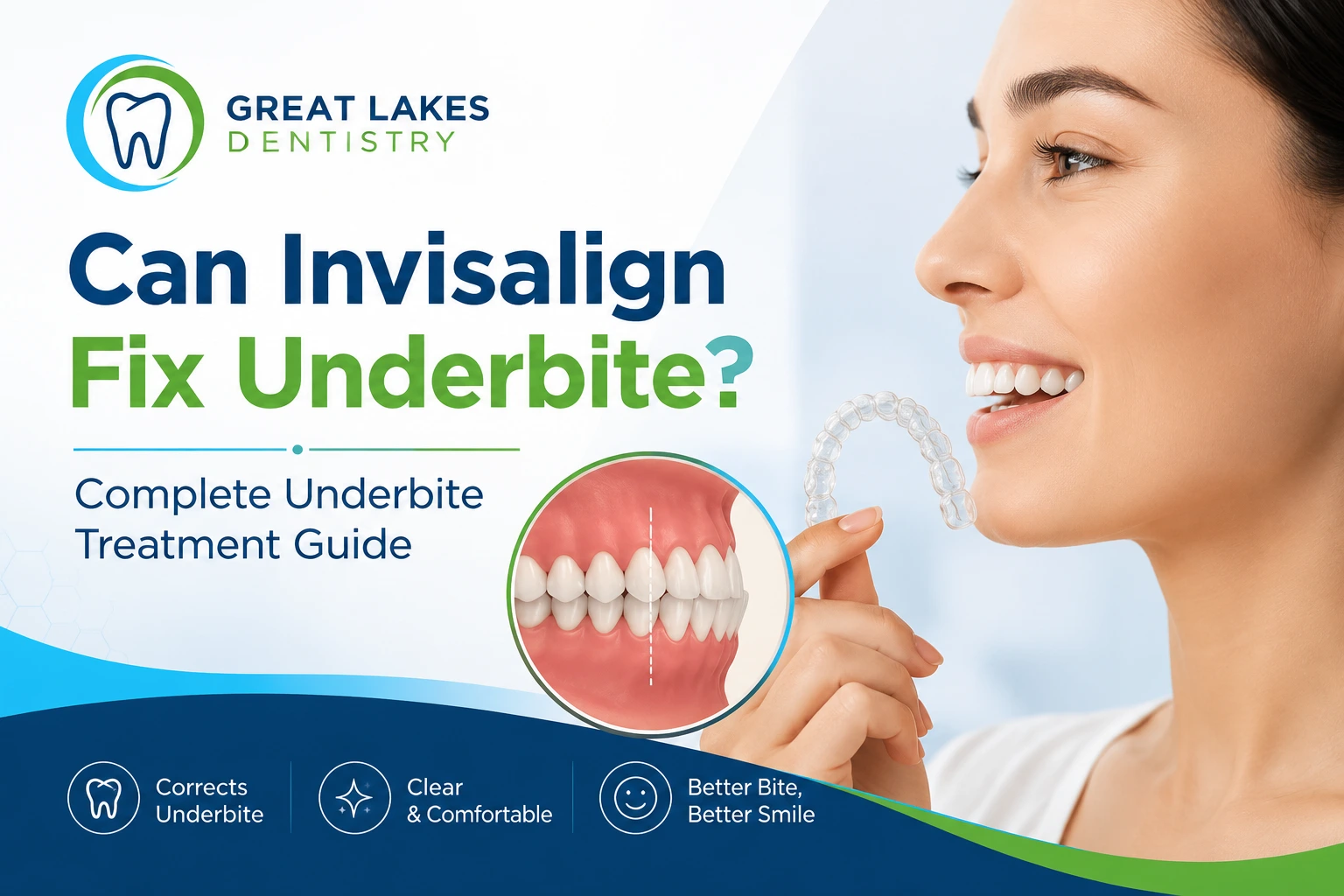
Invisalign can correct mild to moderate underbites — the right treatment depends on your specific bite anatomy
Can Invisalign Fix Underbite? Complete Underbite Treatment Guide
An underbite — where the lower teeth sit in front of the upper teeth when the mouth is closed — is one of the more visually noticeable bite problems patients ask about. Beyond appearance, an uncorrected underbite can cause jaw pain, uneven tooth wear, difficulty chewing, and long-term temporomandibular joint (TMJ) issues. If you’ve been wondering whether Invisalign can fix an underbite, the short answer is: yes, in many cases — but the outcome depends heavily on the severity of your underbite and its underlying cause.
What Is an Underbite?
An underbite — clinically called a Class III malocclusion — occurs when the lower jaw (mandible) protrudes forward relative to the upper jaw (maxilla), causing the lower front teeth to sit ahead of the upper front teeth when biting down.
Underbites range significantly in severity:
- Mild underbite — minimal protrusion, primarily a dental (tooth-position) issue
- Moderate underbite — noticeable protrusion, may involve both dental and skeletal components
- Severe underbite — significant jaw misalignment, primarily skeletal in origin
This distinction matters enormously for treatment planning. Dental underbites — where the issue lies in tooth position rather than jaw structure — are much more responsive to Invisalign treatment. Skeletal underbites, where the jaw bones themselves are differently sized or positioned, often require more comprehensive intervention.
According to the Canadian Dental Association, malocclusions,, including underbites, are among the most common orthodontic concerns affecting Canadian patients, and early assessment is key to identifying the most effective treatment pathway.
What Causes an Underbite?
Understanding the cause of an underbite helps determine the most appropriate treatment. Common causes include:
- Genetics — jaw size and shape are largely inherited; a prominent lower jaw often runs in families
- Childhood habits — prolonged thumb sucking, pacifier use, or mouth breathing can influence jaw development
- Tongue thrusting — habitual forward tongue pressure during swallowing can push the lower jaw forward over time
- Missing upper teeth — gaps in the upper arch can allow the lower jaw to shift forward
- Injury or trauma — damage to the jaw during development can disrupt normal growth patterns
A full clinical evaluation including digital X-rays and bite analysis at Great Lakes Dentistry will determine which factors are driving your specific underbite — and which treatment approach is best suited to your case.
Can Invisalign Fix an Underbite?
Yes — Invisalign can effectively correct mild to moderate dental underbites in both teens and adults. Clear aligners work by applying controlled, gentle force to gradually reposition individual teeth, improving how the upper and lower arches fit together.
For underbites with a significant skeletal component — where the underlying jaw bones are themselves misaligned — Invisalign alone may not be sufficient. In these cases, Invisalign is sometimes used in combination with other interventions, or surgery may be recommended for the most severe presentations.
Here’s a realistic summary of what Invisalign can and cannot address:
Invisalign Can Treat
Mild to moderate underbites caused by tooth position rather than jaw structure. Underbites in teens where jaw growth can be guided with additional appliances. Cases where individual teeth in the lower arch are tipped forward or upper teeth are tipped backward, creating a pseudo-underbite appearance. Mild skeletal underbites in adults where surgery is not desired and some compromise in final result is acceptable.
Invisalign Alone May Not Fully Correct
Severe skeletal underbites where the lower jaw is significantly larger or more forward than the upper. Cases requiring jaw surgery (orthognathic surgery) for stable, complete correction. Growing children under age 10 to 12 whose jaw development is still actively changing and may require interceptive orthodontic appliances first.
How Does Invisalign Correct an Underbite?
When treating an underbite with Invisalign, Dr. Mohi uses a series of precisely sequenced clear aligners to:
- Tip or translate the upper front teeth forward — bringing the upper incisors into a more forward position so they overlap the lower teeth correctly
- Retract the lower front teeth — gently moving lower incisors backward to reduce their protrusion
- Expand the upper arch — in cases where a narrow upper arch contributes to the underbite, controlled expansion can improve the bite
- Use Mandibular Advancement features — Invisalign’s proprietary precision wings (in Invisalign Teen) guide lower jaw repositioning in growing patients
Each set of aligners is worn for approximately two weeks, 20 to 22 hours per day. Progress appointments every 6 to 8 weeks allow Dr. Mohi to monitor tooth movement and make any necessary adjustments to the treatment plan.
In more complex underbite cases, elastics (rubber bands) may be used alongside Invisalign to apply additional corrective force between the upper and lower arches — similar to how elastics work with traditional braces.
Invisalign for Underbite in Teens vs. Adults
Treating Underbite in Teenagers with Invisalign
Teens represent an ideal window for underbite correction because the jaw is still growing and can be guided more effectively. Invisalign Teen — used by our children’s and teen dentistry team at Great Lakes Dentistry — incorporates specialized features including mandibular advancement precision wings and compliance indicators, making it well-suited for bite correction in younger patients.
When detected early, some skeletal underbites in teens can be addressed during the growth phase using a combination of clear aligners and supportive appliances — potentially avoiding surgery later in adulthood.
Treating Underbite in Adults with Invisalign
In adults, jaw growth is complete, which means treatment options depend more on the underbite’s origin. Mild to moderate dental underbites in adults respond well to Invisalign clear aligner therapy. For adults with significant skeletal underbites, orthognathic (jaw) surgery in combination with Invisalign may provide the most stable, complete correction — though many patients opt for orthodontic treatment alone with an accepted compromise in result.
Dr. Mohi will always present all available options transparently, so you can make an informed decision based on your goals, timeline, and budget.
What to Expect During Invisalign Underbite Treatment at Great Lakes Dentistry
Step 1: Comprehensive Consultation and Bite Analysis
Your journey begins with a detailed clinical examination including digital X-rays, bite assessment, and 3D digital scanning. Dr. Mohi will determine the nature and severity of your underbite — dental, skeletal, or both — and outline a treatment plan with a digital preview of your expected result.
Step 2: Customized Aligner Fabrication
Using your 3D digital scan, Invisalign’s ClinCheck software creates a precise, staged tooth movement plan. Custom aligners are fabricated and arrive at our Oakville practice within 2 to 3 weeks. Your treatment plan is designed specifically around your underbite correction — not a generic sequence.
Step 3: Active Treatment Phase
You wear each set of aligners for approximately two weeks. Elastics may be added at certain stages to maximize bite correction. Progress appointments are scheduled every 6 to 8 weeks. Most underbite cases with Invisalign are completed in 12 to 18 months, though mild cases may resolve more quickly.
Step 4: Refinements (If Needed)
Bite corrections — particularly underbites — sometimes benefit from additional refinement aligners after the initial series. These are common, anticipated, and included in comprehensive Invisalign treatment planning at Great Lakes Dentistry.
Step 5: Retainers for Long-Term Stability
Once treatment is complete, retainers are essential. Underbite corrections are particularly susceptible to relapse if retainers are not worn consistently — especially in cases with any skeletal contribution. Dr. Mohi will provide clear guidance on your retainer protocol to protect your results for life.
Invisalign vs. Traditional Braces for Underbite Correction
Both Invisalign and traditional metal braces can effectively correct underbites, but they differ in meaningful ways for patients:
- Aesthetics — Invisalign is nearly invisible; braces are visible metal or ceramic
- Comfort — Invisalign has no brackets or wires; braces can cause irritation to soft tissue
- Compliance — Invisalign requires discipline to wear 20 to 22 hours daily; braces are fixed and non-removable
- Complex cases — traditional braces may offer more precise control for severe or complex bite corrections
- Dietary freedom — Invisalign is removed for eating; braces require food restrictions
For many underbite patients, Invisalign is the preferred choice — particularly adults and teens who prioritize appearance and comfort during treatment. Dr. Mohi will recommend the approach most likely to achieve your specific correction goals.
What Happens If an Underbite Is Left Untreated?
Choosing not to treat an underbite is always an option — but patients should be aware of the potential long-term consequences:
- Accelerated and uneven wear on the front teeth
- Chronic jaw pain and increased risk of TMJ disorders
- Difficulty chewing, particularly with tougher foods
- Speech difficulties, including a lisp or other articulation issues
- Increased risk of chipping or fracturing front teeth due to abnormal bite forces
- Progressive bone loss around teeth subject to excessive force
Early treatment — particularly in the teen years — dramatically reduces the risk of these complications. If you have concerns about an underbite, a consultation at Great Lakes Dentistry is the best first step toward understanding your options.
Invisalign Underbite Treatment Cost in Oakville
The cost of Invisalign underbite treatment varies depending on:
- Severity of the underbite and number of aligners required
- Whether elastics, attachments, or additional appliances are needed
- Whether refinement aligners are required after the initial series
- Whether you are an adult or teen patient
At Great Lakes Dentistry, every patient receives a transparent, written cost estimate before treatment begins — no surprises. Many dental insurance plans cover a portion of Invisalign treatment, and our team offers flexible payment plans to make underbite correction accessible. Eligible patients may also benefit from the Canadian Dental Care Plan (CDCP) — our team can verify your coverage.
Trusted Resources on Orthodontic Treatment and Underbites
- Canadian Dental Association — Oral Health Resources
- Health Canada — Dental Care Guidelines
- World Health Organization — Oral Health Facts
Book Your Underbite Consultation at Great Lakes Dentistry, Oakville
Whether you have a mild underbite or a more complex bite issue, the first step is an honest, thorough assessment with Dr. Gurpreet Mohi. Call us at (905) 825-1212 or book online to find out whether Invisalign is the right solution for your smile.
Frequently Asked Questions: Invisalign for Underbite
Can Invisalign fix an underbite in adults?
Yes — Invisalign can effectively correct mild to moderate dental underbites in adults. For severe skeletal underbites where the jaw bones themselves are significantly misaligned, orthognathic surgery in combination with orthodontic treatment may be needed for the most complete result. Dr. Mohi will assess the nature and severity of your underbite at your consultation and recommend the most appropriate treatment pathway.
How long does Invisalign take to fix an underbite?
Most underbite corrections with Invisalign take between 12 and 18 months, depending on severity and treatment complexity. Mild dental underbites may resolve in as little as 9 to 12 months. Moderate cases requiring elastics or refinements may take 18 months or slightly longer. Dr. Mohi will provide an accurate estimated timeline at your consultation based on your 3D digital scan.
Is Invisalign better than braces for underbite correction?
For mild to moderate underbites, Invisalign and traditional braces achieve comparable results. Invisalign offers advantages in aesthetics, comfort, and dietary freedom during treatment. Traditional braces may provide additional precision for more complex bite corrections. Dr. Mohi will recommend the approach best suited to your specific underbite after a full clinical evaluation.
Can Invisalign fix a severe underbite?
Severe underbites — particularly those with a strong skeletal component — are typically not fully correctable with Invisalign alone. These cases often require orthognathic (jaw) surgery combined with orthodontic treatment for stable, complete correction. However, for patients who prefer to avoid surgery, Invisalign alone can improve a severe underbite to a meaningful degree, with an accepted compromise in the final result.
At what age should an underbite be treated?
Early evaluation is always beneficial. Interceptive treatment in children aged 7 to 11 can guide jaw development and reduce the severity of an underbite before the growth phase ends. Teens aged 12 to 17 are often ideal candidates for Invisalign underbite correction as the jaw is still responsive. Adults of any age can also be treated — though options may differ depending on skeletal involvement.
Will I need to wear elastics with Invisalign for underbite?
In many underbite cases, yes. Elastics (rubber bands) are attached between hooks or precision cuts on upper and lower aligners to apply corrective force between the jaws. They are typically introduced partway through treatment and worn 20 to 22 hours daily alongside aligners. Dr. Mohi will advise whether elastics are part of your treatment plan during your consultation.
Can an underbite come back after Invisalign treatment?
Yes — underbite relapse is possible without consistent retainer wear, particularly in cases with any skeletal contribution. This is why retainer compliance after Invisalign is especially important for underbite patients. Great Lakes Dentistry provides detailed retainer protocols and follow-up appointments to help you protect your results long-term.
Does Invisalign for an underbite hurt?
Invisalign causes mild pressure when switching to a new set of aligners — this is a normal sign that teeth are moving. Most patients find the discomfort manageable and significantly more comfortable than traditional metal braces. The pressure typically resolves within 24 to 48 hours of switching to each new aligner set.
Final Thoughts
Key Takeaways: Can Invisalign Fix an Underbite?
- Invisalign can effectively correct mild to moderate dental underbites in both teens and adults
- Skeletal underbites — where jaw bones are significantly misaligned — may require surgery for complete correction
- Invisalign Teen offers specialized features including mandibular advancement wings for growing patients
- Most underbite cases with Invisalign take 12 to 18 months; elastics are often used for bite correction
- Retainers are essential after treatment — underbite relapse is a real risk without consistent wear
- A comprehensive consultation including 3D scanning and bite analysis is the essential first step