
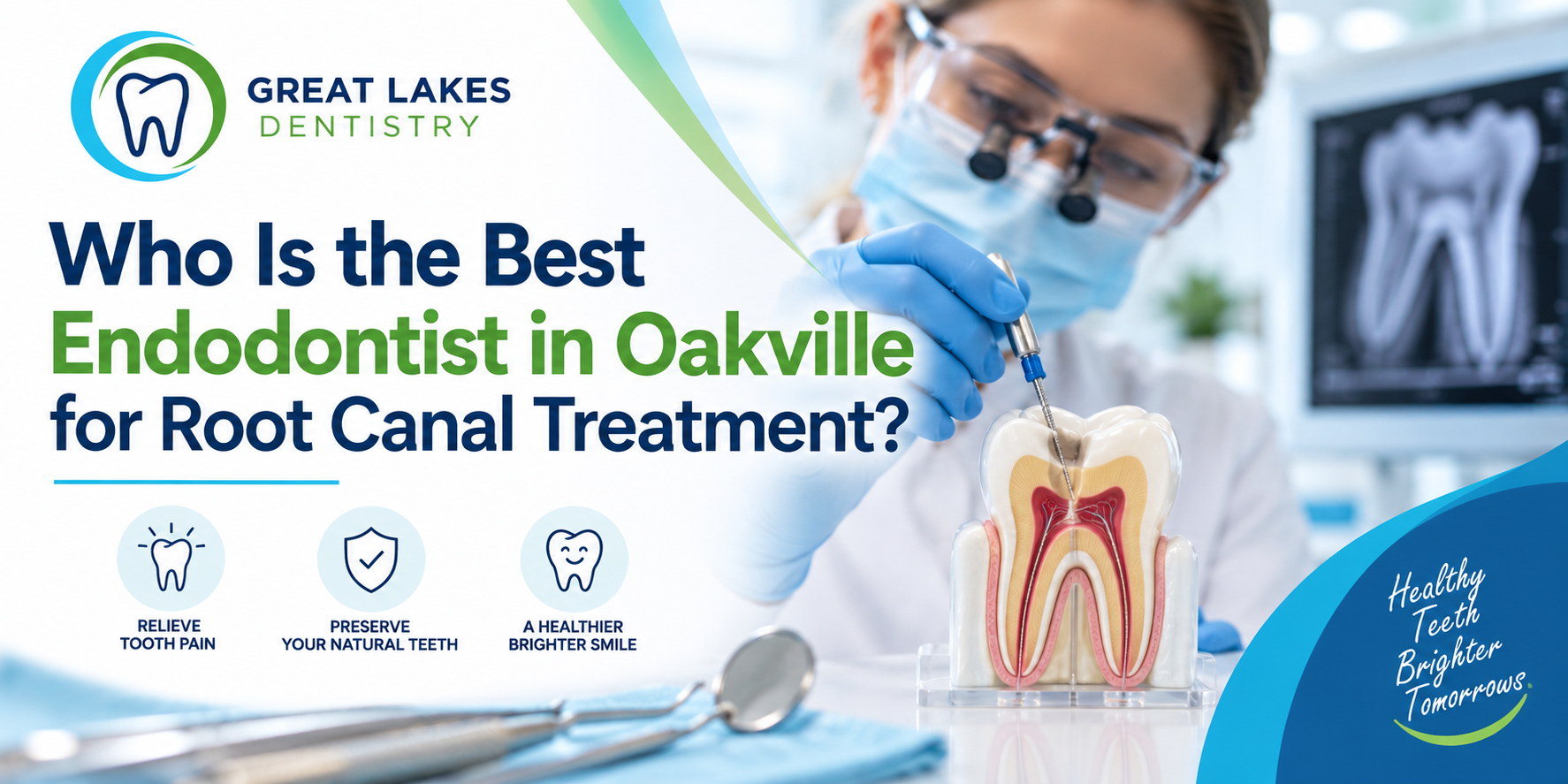
Choosing the right provider for root canal treatment in Oakville means choosing someone with the skills, technology, and patient-first approach to get it right the first time
Who Is the Best Endodontist in Oakville for Root Canal Treatment?
If you have been told you need a root canal — or if you are experiencing the kind of severe, throbbing toothache that often signals one is necessary — you are probably searching for the most skilled, experienced, and comfortable provider in Oakville. The terms “endodontist” and “dentist who performs root canals” are sometimes used interchangeably, but they are not the same thing. Understanding the difference, knowing what to look for in a root canal provider, and knowing what the procedure actually involves will help you make a confident, informed decision about your care.
Endodontist vs General Dentist: Who Should Perform Your Root Canal?
This is the first question most patients ask — and the honest answer is that it depends on the complexity of the case.
An endodontist is a dental specialist who has completed two to three additional years of postgraduate training focused exclusively on diagnosing and treating diseases of the dental pulp and root systems. They perform root canals and related procedures every day and typically have access to advanced magnification and imaging equipment dedicated to pulp and root treatment.
A general dentist with strong restorative and root canal experience can perform the majority of root canal treatments on single-canaled and straightforward multi-canaled teeth with excellent outcomes. Most root canals performed in Canada — the large majority — are completed by experienced general dentists, not endodontists.
The distinction becomes relevant in specific complex situations:
- Teeth with unusually curved, narrow, or calcified root canals
- Re-treatment of a previously failed root canal
- Teeth with additional or anatomically unusual root canals
- Cases involving root-end surgery (apicoectomy)
- Patients with complex medical histories affecting treatment decisions
For the vast majority of patients in Oakville requiring a first-time root canal on a symptomatic or infected tooth, an experienced general dentist with modern diagnostic technology is fully equipped to provide excellent outcomes — often with shorter wait times and better continuity with the rest of your dental care.
What Is Root Canal Treatment and Why Is It Needed?
Root canal treatment — clinically called endodontic therapy — is the removal of infected, inflamed, or dead pulp tissue from the inner chamber and root canals of a tooth. The pulp is the soft tissue at the core of the tooth containing nerves, blood vessels, and connective tissue. When bacterial infection or trauma reaches the pulp, it triggers a severe inflammatory response that produces the characteristic throbbing pain associated with a tooth abscess.
Without treatment, the infection spreads through the root tip into the surrounding bone, forming a periapical abscess. This can lead to bone loss, spread of infection to adjacent teeth, and in severe cases, systemic spread of the infection.
Root canal treatment saves the tooth by eliminating the infection at its source while preserving the external tooth structure. A crown is placed afterward to protect and restore the treated tooth for decades of continued use.
Common reasons root canal treatment is needed include:
- Deep tooth decay that has reached the pulp chamber
- A cracked or fractured tooth with pulp exposure
- Repeated dental procedures on the same tooth causing cumulative pulp trauma
- Trauma from an impact or injury — even without visible fracture
- A dental abscess (infection at the root tip)
Signs You May Need Root Canal Treatment
Root canals are often described as painful — but in reality, the procedure relieves pain. It is the infection causing the agony. Recognizing the signs of pulp infection early leads to simpler treatment and faster relief:
- Severe, persistent toothache — particularly throbbing pain that worsens at night when lying down
- Prolonged sensitivity to heat — pain that lingers 30 seconds or more after a hot drink is removed
- Spontaneous pain — toothache with no obvious trigger, often radiating to the jaw, ear, or temple
- Swelling of the gum or cheek near the affected tooth
- A pimple-like bump on the gum (draining fistula) — indicates an existing abscess
- Tooth darkening — a grey or dark tooth may signal non-vital pulp
- Pain on biting or chewing on a specific tooth
What to Look for in a Root Canal Provider in Oakville
Whether you are seeking an endodontist or an experienced general dentist for root canal treatment, these are the clinical and patient-experience factors that matter most:
1. Diagnostic Technology
Quality root canal treatment begins with quality diagnosis. The provider you choose should use:
- Digital X-rays — higher resolution images with significantly less radiation than traditional film
- 3D cone beam CT imaging (where indicated) — provides three-dimensional views of root anatomy, canal number, curvature, and periapical pathology that flat X-rays cannot show
- Electronic apex locators — precisely determine the length of each root canal during treatment, improving accuracy and reducing the risk of over- or under-instrumentation
2. Magnification and Illumination
Root canals are performed in millimetre-scale spaces. Surgical loupes or a dental operating microscope dramatically improve the clinician’s ability to identify all canal openings, detect micro-cracks, and clean root canal systems thoroughly. Asking whether your provider uses magnification is a legitimate and important question.
3. Rotary Endodontic Instruments
Modern root canal treatment uses nickel-titanium (NiTi) rotary files — flexible, motorized instruments that follow the natural curvature of the root canal to clean and shape it more efficiently and safely than older hand-filing techniques. A provider using rotary endodontic instrumentation delivers consistently better results with less chair time.
4. Patient Comfort and Anxiety Management
Root canal anxiety is real and common. A provider who takes dental anxiety seriously — with effective local anesthesia technique, clear pre-procedure communication, and sedation dentistry options — makes a procedure that many patients dread into one that most patients describe as far more comfortable than expected.
5. Same-Day Assessment for Acute Pain
If you are in severe dental pain, you need to be seen today — not in two weeks. A root canal provider who offers same-day or next-day assessment for patients in acute pain is genuinely patient-centred. At Great Lakes Dentistry, dental pain is always triaged as urgent.
6. Continuity of Care
When your root canal is performed by the same dentist who knows your dental history, has your existing X-rays, and will place your post-treatment crown, the coordination of care is seamless and the clinical context is complete. Splitting root canal treatment between a specialist and your regular dentist introduces handoffs, delays, and communication gaps that are entirely avoidable for most cases.
The Root Canal Procedure — What Actually Happens
Understanding the procedure removes almost all of the anxiety around it. At Great Lakes Dentistry, root canal treatment follows this sequence:
- Diagnosis and imaging — digital X-rays assess root anatomy, canal number, and the extent of periapical pathology before treatment begins
- Local anesthesia — the tooth and surrounding tissue are fully numbed before any instrumentation. For a tooth with active infection, Dr. Mohi may use supplemental anesthetic techniques to ensure complete comfort even in the presence of inflammation
- Rubber dam isolation — a small rubber sheet isolates the tooth during treatment, maintaining a sterile field and preventing irrigant solutions from reaching the throat
- Access opening — a small opening is made through the top of the tooth to access the pulp chamber
- Canal cleaning and shaping — rotary NiTi files clean and shape each root canal to its full length, confirmed with an electronic apex locator and X-ray
- Irrigation — sodium hypochlorite (NaOCl) and EDTA solutions flush the canals repeatedly, dissolving organic debris and bacterial biofilm
- Obturation — the cleaned canals are filled with gutta-percha (a rubber-like material) and sealer cement, sealing the root system against re-infection
- Temporary or permanent restoration — the access opening is sealed immediately. A permanent crown is placed in a subsequent appointment to protect the treated tooth
Most root canals at Great Lakes Dentistry are completed in one to two appointments, typically lasting 60 to 90 minutes each.
Does a Root Canal Hurt?
This is the question every patient asks — and the honest answer consistently surprises people. The root canal procedure itself, performed under effective local anesthesia, is not painful. The vast majority of patients describe their experience as comparable to having a filling placed.
What patients feel before the procedure is the infection — and the root canal ends that pain. Most patients leave their root canal appointment with immediate or rapid relief from the severe toothache that brought them in.
Mild soreness in the treated tooth for 2 to 5 days after the procedure is normal and expected — the result of instrumentation in a previously inflamed tissue. This is managed easily with over-the-counter ibuprofen or acetaminophen in most cases.
According to the Canadian Dental Association, root canal treatment has a success rate exceeding 95% and is one of the most reliable procedures in restorative dentistry when performed by an experienced clinician with appropriate diagnostic technology.
After Root Canal Treatment: The Crown Appointment
A tooth that has undergone root canal treatment becomes more brittle over time as its internal blood supply is removed. Without a crown, treated back teeth are at significantly elevated risk of fracturing under normal biting forces — a fracture that may ultimately require extraction.
Placing a crown over the root canal treated tooth is not optional for posterior teeth — it is the completion of treatment and the step that protects the investment made in saving the tooth. Patients who delay or skip the crown after a root canal frequently end up losing the tooth to fracture within a few years.
At Great Lakes Dentistry, crown placement is coordinated as part of the complete root canal treatment plan — typically scheduled within two to four weeks of the root canal appointment.
Trusted Resources on Root Canal Treatment
- Canadian Dental Association — Oral Health Resources
- Health Canada — Dental Care Guidelines
- World Health Organization — Oral Health Facts
Need Root Canal Treatment in Oakville? Call Great Lakes Dentistry Today
Do not wait in pain. Dr. Gurpreet Mohi and our team provide same-day assessment for patients with acute dental pain — and perform root canal treatment with modern rotary instrumentation, digital imaging, and sedation options. Call (905) 825-1212 or book online now.
Frequently Asked Questions: Root Canal Treatment in Oakville
Do I need to see a specialist (endodontist) for a root canal in Oakville?
Not necessarily. The large majority of root canals — including most first-time treatments on infected or symptomatic teeth — are successfully performed by experienced general dentists. An endodontist referral is typically recommended for complex cases involving unusually curved or calcified root canals, re-treatment of previously failed root canals, or root-end surgery. Dr. Mohi will advise honestly at your assessment whether your case is within our scope or warrants specialist referral.
Is a root canal painful?
The procedure itself is performed under local anesthesia and should not be painful. Most patients are genuinely surprised by how comfortable the experience is. What causes the pain patients associate with root canals is the infection — not the treatment. The root canal procedure ends that pain. Mild soreness in the treated tooth for 2 to 5 days afterward is normal and manageable with over-the-counter pain relief.
How many appointments does a root canal take?
Most root canals at Great Lakes Dentistry are completed in one or two appointments of approximately 60 to 90 minutes each. Single-visit root canals are possible for most straightforward cases. Teeth with active abscess, multiple canals, or complex anatomy may require two appointments. A crown appointment follows the root canal — typically 2 to 4 weeks later.
What happens if I don’t get a root canal when I need one?
Without treatment, the bacterial infection causing your symptoms will spread through the root tip into the surrounding jawbone, forming a periapical abscess. This leads to progressive bone loss, potential spread of infection to adjacent teeth, and increased risk of systemic spread — including the rare but documented life-threatening spread to the jaw, neck, and airway. The tooth will ultimately be lost. Early treatment is always the simpler, less painful, and less costly choice.
How long does a root canal treated tooth last?
With proper restoration — specifically, a crown placed promptly after treatment — a root canal treated tooth can last decades or a lifetime. The Canadian Dental Association reports root canal treatment success rates exceeding 95%. The most common reason root canal treated teeth fail long-term is fracture due to delayed or absent crown placement, or recurrent infection from an inadequate coronal seal. Following through on the crown appointment is essential to protecting the investment in your treated tooth.
Does insurance cover root canal treatment in Ontario?
Most Canadian dental insurance plans provide coverage for root canal treatment under their restorative benefits — typically between 50% and 80% of the procedure cost, depending on your plan. Coverage levels vary. The Canadian Dental Care Plan (CDCP) may also provide eligible patients with benefits toward endodontic treatment. Great Lakes Dentistry submits insurance claims directly and can provide a pre-determination so you know your out-of-pocket cost before treatment begins.
Is extraction cheaper than a root canal?
An extraction is typically less expensive upfront — but the full cost picture changes dramatically when tooth replacement is considered. An extracted tooth should be replaced (typically with an implant or bridge) to prevent bone loss, bite shift, and adjacent tooth problems. The total cost of extraction plus implant almost always exceeds the cost of root canal treatment plus crown. Saving the natural tooth is nearly always the most cost-effective long-term choice when treatment is clinically viable.
What should I do if I am in severe tooth pain right now?
Call Great Lakes Dentistry at (905) 825-1212 immediately. We triage dental pain as urgent and offer same-day assessment for patients in acute discomfort. While waiting for your appointment, take ibuprofen as directed (it reduces both pain and inflammation around the infected tooth), apply a cold compress to the cheek in 20-minute intervals, and avoid very hot, cold, or sweet foods on the affected side. Do not delay — a dental abscess is a progressive infection that worsens without professional treatment.
Final Thoughts
Key Takeaways: Root Canal Treatment in Oakville
- Most root canals do not require a specialist — an experienced general dentist with modern technology provides excellent outcomes for the majority of cases
- Root canal treatment relieves pain — it does not cause it. The infection is the source of the agony
- Modern rotary instrumentation, digital imaging, and effective anesthesia make root canals far more comfortable than their reputation suggests
- Success rates exceed 95% — root canal treatment is one of the most reliable procedures in dentistry
- Crown placement after the root canal is essential for back teeth — skipping it puts the tooth at high fracture risk
- Great Lakes Dentistry offers same-day assessment for dental pain — call (905) 825-1212 now