
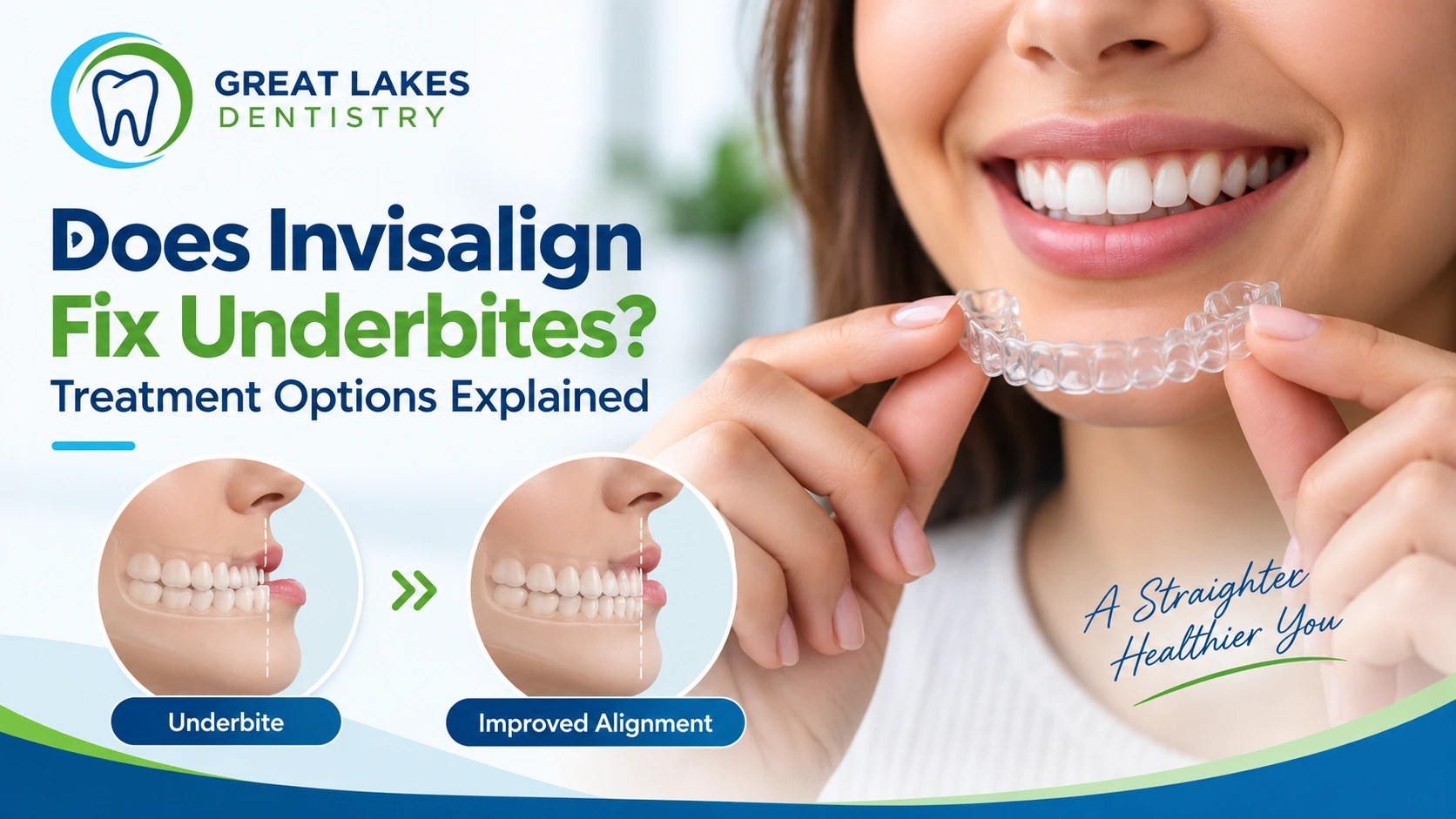
Invisalign can effectively correct many underbites — but the right treatment depends on what is causing yours and how severe it is
Does Invisalign Fix Underbites? Treatment Options Explained
An underbite — where the lower teeth sit in front of the upper teeth when biting down — is one of the more complex bite problems in orthodontics. Patients increasingly ask whether Invisalign can correct it, drawn by the appeal of clear, removable aligners over traditional metal braces. The answer is nuanced: yes, Invisalign can fix many underbites — but the success of treatment depends entirely on understanding what type of underbite you have, what is causing it, and which treatment approach is clinically appropriate for your specific anatomy. This guide breaks down underbite causes, all available treatment options, and exactly how Invisalign fits into the picture.
Understanding Underbites: Not All Are the Same
The clinical term for an underbite is a Class III malocclusion — but within that classification, there are fundamentally different types of underbite that require completely different treatment approaches.
Dental Underbite
A dental underbite is caused by the position of the teeth rather than the underlying jaw bones. The jaws themselves may be normally sized and positioned, but individual teeth in the lower arch are tipped forward, or upper teeth are tipped backward, creating the appearance and functional problem of an underbite.
Dental underbites are the most responsive to Invisalign. Clear aligner therapy is designed precisely to reposition individual teeth — tipping, rotating, and translating them into correct alignment. For a dental underbite, Invisalign can achieve full correction in most cases.
Skeletal Underbite
A skeletal underbite occurs when the problem lies in the jaw bones themselves — the lower jaw (mandible) is proportionally longer or more forward than the upper jaw (maxilla), or the upper jaw is underdeveloped. The tooth positions may be normal relative to their respective jaws, but the jaws are mismatched in size or projection.
Skeletal underbites are the most common underlying cause of significant underbites, and they present the greatest challenge for Invisalign alone. Mild skeletal underbites can often be meaningfully improved with clear aligner therapy. Moderate to severe skeletal underbites — particularly in adults with completed jaw growth — typically require jaw surgery (orthognathic surgery) for complete, stable correction.
Combined Underbite
Many patients have a combination of dental and skeletal components — some tooth position issues overlaid on a jaw relationship that is not perfectly matched. Treatment for combined underbites must address both elements for the most complete result.
Understanding which type of underbite you have is the essential first step — and it cannot be determined from a photograph or a description. It requires clinical examination, digital X-rays, and a cephalometric (head X-ray) analysis of jaw relationships.
Treatment Options for Underbites: A Complete Overview
The appropriate treatment for an underbite depends on its type, severity, the patient’s age, and their goals. Here is a clear overview of all available options:
Option 1: Invisalign Clear Aligners
Invisalign corrects underbites by repositioning individual teeth through a precisely sequenced series of custom aligners. For underbite correction specifically, the treatment typically involves:
- Tipping the upper front teeth forward — moving the upper incisors into a more forward, overlapping position
- Retracting the lower front teeth — moving the lower incisors backward to reduce their protrusion relative to the upper arch
- Upper arch expansion — widening the upper arch where a narrow upper jaw contributes to the underbite
- Inter-arch elastics — rubber bands worn between upper and lower aligners to apply additional corrective force between the jaws. Used in the majority of underbite cases alongside aligners
- Mandibular advancement features — in Invisalign Teen, precision wings guide lower jaw repositioning during active growth
Best for: Mild to moderate dental underbites in teens and adults. Teens in active jaw growth where the mandibular advancement feature can guide development. Adults with mild skeletal underbites who prefer to avoid surgery.
Typical timeline: 12 to 18 months for most underbite cases, with check-in appointments every 6 to 8 weeks.
Option 2: Traditional Metal or Ceramic Braces
Traditional braces use metal or ceramic brackets bonded to each tooth, connected by an archwire that applies controlled force to move teeth. For underbite correction, braces are often used with Class III elastics connecting the upper and lower arches to apply corrective inter-arch force.
Braces offer a degree of precision that can be advantageous in more complex tooth-movement scenarios — and they are non-removable, eliminating compliance concerns. For severe or complex dental underbites, many orthodontists prefer braces for their mechanical control.
Best for: Complex dental underbites requiring precise multi-directional tooth movement. Patients who cannot maintain the compliance required by Invisalign. Cases involving significant tooth rotation or bodily movement.
Option 3: Growth Modification Appliances (Children)
For children aged 7 to 12 who are still in active jaw growth, a Facemask (reverse pull headgear) or chin cup can influence the direction and rate of jaw development. These appliances work by applying external force to the upper jaw to encourage its forward growth relative to the lower jaw.
Growth modification is only effective during active growth phases — it cannot reposition completed adult bones. However, successful early intervention can reduce the severity of an underbite significantly, and in some cases may prevent the need for jaw surgery later in life.
Best for: Children ages 7 to 12 with developing skeletal underbites. Early interceptive treatment to guide jaw growth and reduce future treatment complexity.
Option 4: Orthognathic (Jaw) Surgery Combined with Orthodontics
For adults with significant skeletal underbites — where the jaw bones themselves are substantially mismatched — orthognathic surgery combined with orthodontic treatment (Invisalign or braces) is the only option that provides complete, stable correction.
The typical combined treatment sequence is:
- Pre-surgical orthodontics (6 to 12 months) — aligns the teeth within each arch independently before surgery
- Jaw surgery — the surgeon repositions the upper jaw (Le Fort I osteotomy), lower jaw (bilateral sagittal split osteotomy), or both, to correct the skeletal discrepancy
- Post-surgical orthodontics (6 to 12 months) — fine-tunes tooth position and bite relationship after the jaws have healed
Best for: Adults with moderate to severe skeletal underbites. Cases where Invisalign alone cannot achieve a stable, complete bite correction. Patients who want the most complete and permanent resolution of their underbite.
How to Know Which Treatment Is Right for You
The honest answer is that no online guide — including this one — can determine this for you. The decision between Invisalign, braces, growth modification, and surgery requires:
- A full clinical examination of your bite, teeth, and jaw relationships
- Digital X-rays including a cephalometric analysis of jaw angles and positions
- 3D digital scanning to assess tooth positions and arch dimensions
- A thorough discussion of your goals, timeline, and tolerance for different treatment approaches
Invisalign for Underbites: Realistic Expectations
Patients considering Invisalign for an underbite should have clear, realistic expectations about what the treatment can and cannot achieve:
What Invisalign Can Achieve
Full correction of mild to moderate dental underbites. Meaningful improvement of mild skeletal underbites (with accepted compromise in final result). Guided jaw repositioning in teens using mandibular advancement features. Combined correction using inter-arch elastics for additional bite force. Completion in 12 to 18 months for most cases. Near-invisible treatment with no brackets or wires.
Where Invisalign Has Limits
Cannot fully correct significant skeletal underbites in adults with completed jaw growth. Cannot move jaw bones — only tooth positions. Requires strict 20 to 22 hours daily wear for results. Underbite relapse risk is higher than for crowding cases — retainer compliance after treatment is critical. Results in skeletal cases involve a compromise that patients must clearly understand before committing.
Retainers After Underbite Treatment — More Critical Than You Think
Underbite corrections — particularly those with any skeletal component — are among the most relapse-prone orthodontic results. The jaw and surrounding musculature have a strong memory of their previous position, and without consistent retainer wear, teeth and even jaw position can drift back toward the original underbite.
After Invisalign underbite treatment, Dr. Mohi typically recommends:
- Full-time retainer wear for the first 6 to 12 months post-treatment
- Nightly wear indefinitely to maintain the corrected bite long-term
- In some cases, a fixed bonded retainer on the lower front teeth for permanent passive retention
Retainer compliance after underbite treatment is not optional — it is the difference between a lasting result and a disappointing relapse.
The Cost of Invisalign for Underbite Treatment in Oakville
Invisalign underbite treatment costs vary based on:
- Severity of the underbite and number of aligners required
- Whether elastics, attachments, or refinements are needed
- Whether preparatory dental work is required (e.g. deep cleaning before orthodontic treatment begins)
- Teen vs adult treatment protocols
At Great Lakes Dentistry, every patient receives a written, itemized cost estimate before treatment begins. Many dental insurance plans cover a portion of Invisalign treatment, and flexible payment plans are available. Our team also verifies eligibility for the Canadian Dental Care Plan (CDCP) and submits claims on your behalf.
According to the Canadian Dental Association, orthodontic treatment that corrects bite alignment contributes not only to aesthetics but to long-term oral health — reducing uneven wear, TMJ strain, and the risk of dental injury from misaligned bites.
Trusted Resources on Orthodontic Treatment and Underbites
- Canadian Dental Association — Oral Health Resources
- Health Canada — Dental Care Guidelines
- World Health Organization — Oral Health Facts
Find Out If Invisalign Can Fix Your Underbite — Book a Consultation in Oakville
The only way to know which underbite treatment is right for you is a comprehensive clinical assessment. Call Dr. Gurpreet Mohi and our team at (905) 825-1212 or book online today.
Frequently Asked Questions: Does Invisalign Fix Underbites?
Can Invisalign fully correct an underbite?
Invisalign can fully correct mild to moderate dental underbites — where the problem is tooth position rather than jaw structure. For skeletal underbites in adults (where the jaw bones themselves are mismatched in size or position), Invisalign can provide meaningful improvement but not complete correction without surgery. A clinical assessment including cephalometric X-ray analysis is required to determine how much of your underbite is dental versus skeletal.
What is the difference between a dental and skeletal underbite?
A dental underbite is caused by the position of the teeth — individual teeth are tipped or positioned incorrectly, creating the underbite appearance. A skeletal underbite is caused by the jaw bones themselves — the lower jaw is proportionally longer or more forward than the upper jaw. Dental underbites respond well to Invisalign. Skeletal underbites in adults typically require jaw surgery for complete correction. Many patients have a combination of both.
How long does Invisalign take to correct an underbite?
Most underbite corrections with Invisalign take between 12 and 18 months, depending on severity and complexity. Mild dental underbites may resolve in 9 to 12 months. Cases requiring elastics and refinement aligners may take 18 months or slightly longer. Dr. Mohi provides an accurate timeline estimate at your consultation based on your 3D digital scan and bite analysis.
Will I need to wear elastics with Invisalign for my underbite?
In most underbite cases, yes. Orthodontic elastics (rubber bands) attached between upper and lower aligners apply corrective inter-arch force that the aligners alone cannot generate. They are worn 20 to 22 hours daily alongside aligners and are introduced at the appropriate stage of treatment. Elastic compliance is as important as aligner wear time for achieving the planned bite correction.
Can children get Invisalign for an underbite?
Invisalign Teen includes specialized mandibular advancement features designed to guide lower jaw repositioning during active growth — making it particularly well-suited for teenagers with underbites. For younger children (ages 7 to 12), growth modification appliances like a facemask may be recommended first to guide jaw development before orthodontic tooth alignment begins. Dr. Mohi will advise on the most appropriate timing and approach at your child’s assessment.
Is jaw surgery necessary for an underbite?
Jaw surgery is necessary only for adults with significant skeletal underbites — where the jaw bones themselves are substantially mismatched. Orthodontic treatment alone (Invisalign or braces) can correct dental underbites and meaningfully improve mild skeletal underbites with an accepted compromise. Moderate to severe skeletal underbites in adults typically require orthognathic surgery for complete, stable correction. For children, growth modification during the growth phase can sometimes prevent the need for surgery later.
Will my underbite come back after Invisalign treatment?
Underbite relapse is possible without consistent retainer wear — particularly in cases with any skeletal component. Underbites are among the more relapse-prone orthodontic corrections because jaw musculature has a strong memory of its previous position. Great Lakes Dentistry provides detailed retainer protocols after Invisalign underbite treatment, typically recommending full-time wear for 6 to 12 months followed by lifelong nightly wear.
How do I know if my underbite is dental or skeletal?
You cannot determine this from a self-examination or photograph. Distinguishing a dental from a skeletal underbite requires a clinical bite assessment, digital X-rays, and a cephalometric analysis measuring jaw angles, projection, and relationships. Dr. Mohi performs this full assessment at your Invisalign consultation — and provides a clear, honest explanation of what type of underbite you have and which treatment options are realistically appropriate for your case.
Final Thoughts
Key Takeaways: Does Invisalign Fix Underbites?
- Invisalign can fully correct mild to moderate dental underbites and meaningfully improve mild skeletal underbites
- Significant skeletal underbites in adults typically require jaw surgery for complete correction
- The key distinction — dental vs skeletal underbite — requires clinical examination and cephalometric X-ray analysis to determine
- Most Invisalign underbite cases use inter-arch elastics alongside aligners for additional corrective bite force
- Retainer compliance after treatment is especially critical for underbites — relapse risk is higher than for most other corrections
- Early treatment in children can guide jaw growth and reduce future treatment complexity significantly