
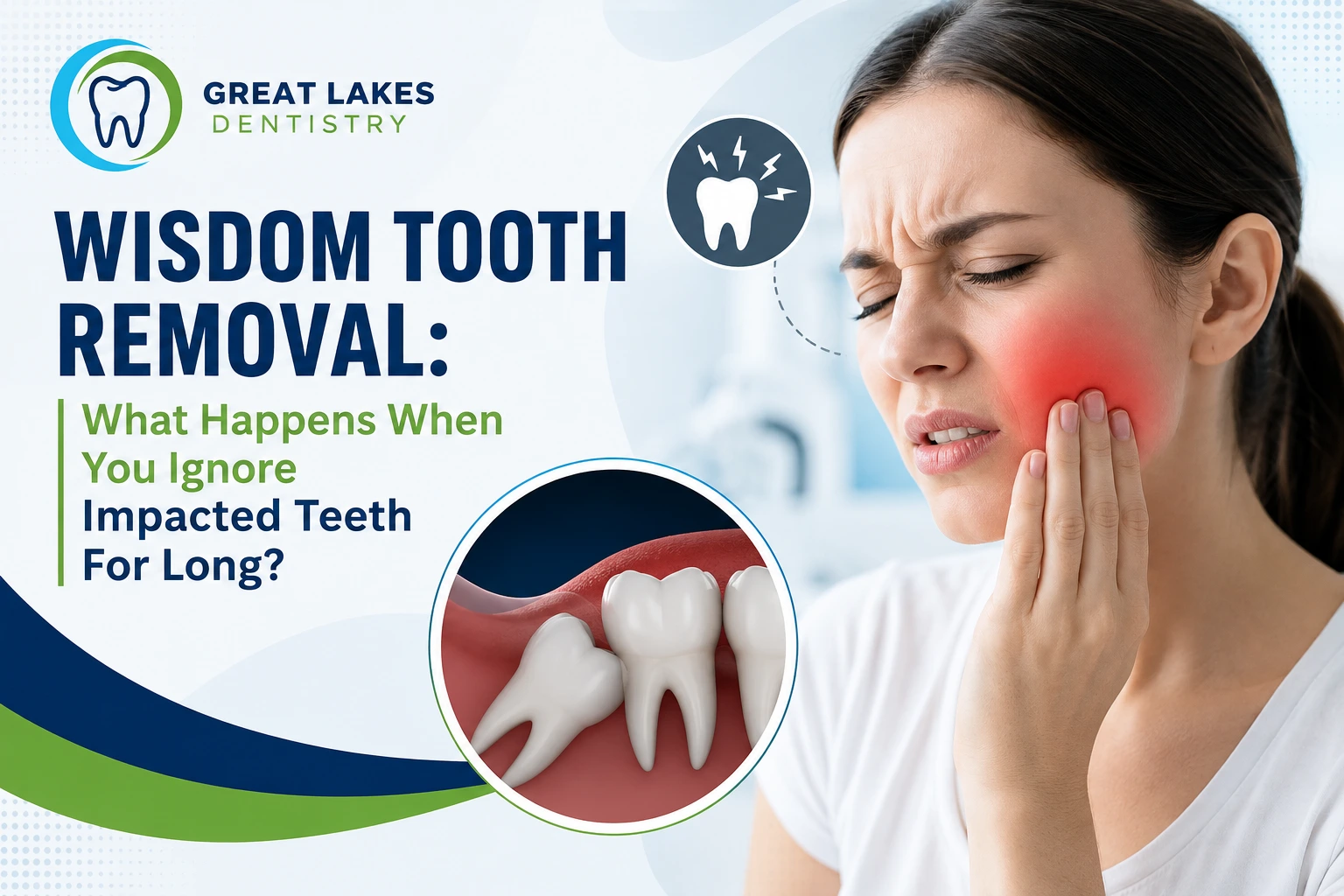
Ignoring impacted wisdom teeth rarely ends well — the longer they remain untreated, the more complex and costly the consequences become
Wisdom Tooth Removal: What Happens When You Ignore Impacted Teeth For Long?
Impacted wisdom tooth removal are among the most common dental diagnoses — and among the most commonly ignored. Many patients discover their wisdom teeth are impacted during a routine X-ray, feel no symptoms, and decide to wait. Others experience periodic discomfort, take pain relief, and hope the problem resolves on its own. It almost never does. What starts as a minor positional issue can, over months and years, evolve into serious infection, permanent damage to neighbouring teeth, cyst formation, and bone loss — all of which are significantly more complex and expensive to treat than a straightforward extraction would have been. This guide explains what impacted wisdom teeth actually do to your mouth when left untreated — and why timing matters more than most patients realize.
What Is an Impacted Wisdom Tooth?
Wisdom teeth — the third molars — are the last permanent teeth to develop, typically erupting between the ages of 17 and 25. In most modern mouths, there is simply not enough space at the back of the jaw to accommodate them properly. When a wisdom tooth cannot fully erupt into its correct position, it becomes impacted — trapped against the jawbone, the adjacent molar, or the overlying gum tissue.
Impacted wisdom teeth are classified by their orientation:
- Mesial impaction — the tooth is angled forward toward the second molar. The most common type and often the most damaging to the adjacent tooth
- Horizontal impaction — the tooth lies completely sideways, pointing directly into the root of the second molar
- Vertical impaction — the tooth is correctly oriented but cannot fully emerge through the bone or gum
- Distal impaction — the tooth is angled backward toward the back of the jaw
Some impacted wisdom teeth partially break through the gum (partially impacted), while others remain entirely beneath the gum and bone (fully impacted). Both types carry significant risks when left untreated — the difference is that partially impacted teeth often cause symptoms sooner, while fully impacted teeth can cause extensive damage silently for years.
The Consequences of Ignoring Impacted Wisdom Teeth
1. Pericoronitis — Recurrent Infection of the Gum Flap
When a wisdom tooth partially breaks through the gum, a flap of gum tissue (called the operculum) often covers part of the crown. Food particles and bacteria accumulate beneath this flap — an environment that is nearly impossible to clean adequately with a toothbrush. The result is pericoronitis: an infection of the soft tissue surrounding the partially erupted tooth.
Pericoronitis produces:
- Swelling and redness of the gum tissue behind the last molar
- Significant pain that often radiates to the ear, jaw, and throat
- Difficulty opening the mouth (trismus)
- An unpleasant taste or foul odour from the infected area
- Fever and swollen lymph nodes in severe cases
Pericoronitis frequently recurs. Each episode is typically treated with antibiotics and irrigation — but these measures address the infection, not the cause. As long as the partially impacted tooth and its gum flap remain, the infection returns. Repeated courses of antibiotics carry their own risks, and the repeated inflammatory cycles cause cumulative damage to surrounding tissue and bone.
2. Damage to the Adjacent Second Molar
This is one of the most serious — and most underappreciated — consequences of leaving impacted wisdom teeth untreated. A wisdom tooth pressing against the root of the adjacent second molar exerts continuous mechanical pressure, causing:
- External root resorption — the root of the second molar is literally dissolved by pressure from the impacted wisdom tooth. This damage is often irreversible and may ultimately require extraction of the second molar as well
- Cavity formation on the second molar — the contact point between the impacted wisdom tooth and the second molar creates a space that is impossible to clean, allowing decay to develop on the root surface of the adjacent tooth
- Bone loss between the two teeth — the chronic inflammation around the impaction creates a periodontal defect between the wisdom tooth and second molar, resulting in bone loss that persists even after the wisdom tooth is eventually removed
The critical point here is that by the time this damage is detected on an X-ray, it has already occurred. The second molar — which is a far more important functional tooth than the wisdom tooth — has been permanently compromised. Early extraction of the impacted wisdom tooth prevents this damage entirely.
3. Dental Cysts and Tumours
Every impacted wisdom tooth develops within a follicular sac — a small fluid-filled structure that surrounded the tooth as it formed. When a wisdom tooth remains impacted, this sac can enlarge into a dentigerous cyst: a fluid-filled lesion that slowly expands within the jawbone.
Dentigerous cysts:
- Expand gradually and silently — often producing no symptoms until they are large
- Destroy surrounding jawbone as they enlarge
- Can displace neighbouring teeth, nerve canals, and anatomical structures
- Occasionally transform into more aggressive lesions — including odontogenic tumours — if left untreated for very long periods
- Require surgical removal of the cyst and often reconstruction of the affected bone
Regular dental X-rays — including panoramic radiographs that show the full jaw — are essential for detecting cystic change around impacted wisdom teeth before they become large. This is one of the most compelling clinical reasons to have impacted wisdom teeth monitored even when they produce no symptoms.
4. Crowding and Shifting of the Front Teeth
Whether impacted wisdom teeth directly cause crowding of the front teeth is a longstanding debate in dentistry. The current evidence suggests that while wisdom teeth are not the primary driver of crowding, the forward pressure they exert as they push against the dental arch can contribute to or exacerbate shifting — particularly in patients who have had orthodontic treatment and are relying on their alignment being maintained.
For patients who have invested in orthodontic treatment — whether with Invisalign or traditional braces — removal of impacted wisdom teeth is often recommended to protect the alignment achieved through treatment. The risk of post-orthodontic relapse due to wisdom tooth pressure is a real consideration in treatment planning.
5. Abscess and Spread of Infection
An untreated pericoronitis or decay around an impacted tooth can progress to a full dental abscess — a bacterial infection that spreads into the surrounding bone and soft tissue. In the lower jaw, dental abscesses near wisdom teeth are particularly concerning because of their anatomical proximity to the floor of the mouth and the neck.
In rare but well-documented cases, untreated dental infections from impacted wisdom teeth have spread to the deep spaces of the neck — a life-threatening condition called Ludwig’s angina — or ascended into the intracranial compartment. These outcomes are uncommon, but they are a documented consequence of long-term neglect of impacted wisdom teeth that become infected.
According to the Canadian Dental Association, early assessment and timely management of impacted wisdom teeth prevents the vast majority of these serious complications — making proactive evaluation one of the most important preventive actions a patient can take.
6. Chronic Jaw Pain and TMJ Complications
Impacted wisdom teeth — particularly those in the lower jaw — exert chronic pressure on surrounding structures, including the jaw joint (temporomandibular joint, or TMJ). Patients with long-standing impacted wisdom teeth frequently report:
- Persistent jaw aching that is difficult to localize
- Headaches originating from the jaw area
- Difficulty fully opening the mouth
- Clicking or discomfort in the TMJ area
While TMJ disorders have multiple causes, impacted wisdom teeth are a contributing factor that is entirely removable. Many patients who have wisdom teeth extracted report significant improvement in chronic jaw discomfort that they had attributed to stress or tension.
When Is the Right Time to Have Wisdom Teeth Removed?
The optimal timing for wisdom tooth removal is a question Dr. Mohi addresses at every wisdom tooth assessment. The answer depends on:
- The degree of impaction and the tooth’s current position relative to adjacent structures
- Whether symptoms such as pain, swelling, or infection are present
- Evidence of cyst formation, root resorption of the adjacent tooth, or bone loss on X-ray
- The patient’s age — younger patients (late teens to mid-20s) have shorter roots, softer bone, and faster healing than older patients, making early removal significantly less complex
- The patient’s overall health and any medical conditions that affect surgical risk
What Does Wisdom Tooth Removal Involve?
Many patients delay extraction because they fear the procedure. Understanding what the process actually involves almost always reduces this anxiety significantly:
- Assessment and imaging — a panoramic X-ray or 3D CT scan is taken to assess root anatomy, proximity to the inferior alveolar nerve, and surgical complexity
- Local anesthesia — the treatment area is fully numbed before any instrumentation begins. Sedation dentistry is available for anxious patients
- Surgical removal — depending on the impaction type, the tooth may be sectioned into pieces for safer, less traumatic removal. Most procedures take 20 to 45 minutes per tooth
- Recovery — soft tissue healing takes 1 to 2 weeks. Bone remodeling continues for several months. Most patients return to normal activity within 3 to 5 days
Post-operative care instructions are provided at Great Lakes Dentistry before you leave the chair — covering diet, medication, oral hygiene, and warning signs to watch for during recovery.
Trusted Resources on Wisdom Teeth and Oral Surgery
- Canadian Dental Association — Oral Health Resources
- Health Canada — Dental Care Guidelines
- World Health Organization — Oral Health Facts
Impacted Wisdom Teeth in Oakville? Book Your Assessment Today
Do not wait for symptoms to become severe. Call Dr. Gurpreet Mohi and our team at (905) 825-1212 or book online for a comprehensive wisdom tooth assessment — including imaging and an honest recommendation based on your specific anatomy and risk level.
Frequently Asked Questions: Wisdom Tooth Removal and Impacted Teeth
What happens if I leave impacted wisdom teeth untreated?
Leaving impacted wisdom teeth untreated can lead to recurrent infection (pericoronitis), decay and root resorption of the adjacent second molar, cyst formation that destroys jawbone, abscess and spread of infection, chronic jaw pain, and in rare cases life-threatening spread of dental infection to the neck and beyond. The consequences are progressive — they worsen over time and become more complex and costly to manage the longer treatment is delayed.
Can impacted wisdom teeth cause damage with no symptoms?
Yes — and this is one of the most important points about impacted wisdom teeth. Fully impacted teeth in particular can cause significant damage — including root resorption of the adjacent molar and cyst formation — entirely without symptoms. This is why regular dental X-rays, including panoramic radiographs, are essential for monitoring impacted wisdom teeth even when the patient feels no discomfort. Damage discovered on imaging has already occurred — the goal is to catch it before it begins.
At what age should wisdom teeth be removed?
If removal is indicated, the late teens to mid-20s are generally the optimal window — roots are shorter, bone is less dense, and healing is faster and more complete. However, wisdom teeth can be safely removed at any age. The decision is based on clinical assessment, imaging findings, and the individual patient’s anatomy and health — not age alone. Earlier intervention is nearly always simpler when removal is recommended.
Is wisdom tooth removal painful?
The procedure is performed under local anesthesia and is not painful during the extraction itself. Sedation dentistry is available for anxious patients at Great Lakes Dentistry. Post-operative discomfort is normal for 3 to 5 days and is managed with prescribed or over-the-counter pain relief. Most patients are surprised by how manageable recovery is — particularly when the procedure is performed before the roots are fully developed.
What is pericoronitis and how is it treated?
Pericoronitis is an infection of the gum tissue surrounding a partially impacted wisdom tooth. It produces pain, swelling, difficulty opening the mouth, bad taste, and sometimes fever. Initial treatment involves antibiotics and irrigation of the infected area. However, because the structural cause — the partially erupted tooth and its gum flap — remains, pericoronitis typically recurs until the wisdom tooth is removed. Extraction is the definitive treatment.
Can impacted wisdom teeth damage the neighbouring molar?
Yes — this is one of the most serious consequences of delayed wisdom tooth removal. Pressure from a mesially or horizontally impacted wisdom tooth can cause external root resorption of the adjacent second molar, decay on its root surface, and bone loss between the two teeth. By the time this damage is visible on an X-ray, it has already occurred. Early removal of the impacted wisdom tooth prevents this damage entirely.
How long does recovery take after wisdom tooth removal?
Soft tissue healing typically takes 1 to 2 weeks. Most patients return to normal activities within 3 to 5 days. Bone remodeling at the extraction site continues for several months. Recovery is generally faster and more straightforward in younger patients with shorter roots and less dense bone. Following post-operative instructions — particularly regarding diet, oral hygiene, and avoiding straws — significantly affects healing speed and comfort.
Do all impacted wisdom teeth need to be removed?
Not necessarily. Some fully impacted wisdom teeth that are not causing damage, not associated with cyst formation, and pose no threat to adjacent teeth may be monitored rather than extracted — particularly in older patients where surgical risk is higher. However, monitoring requires regular X-ray review to detect any change. The decision is made individually based on imaging, anatomy, symptoms, and the patient’s overall health. Dr. Mohi will give you an honest, evidence-based recommendation at your assessment.
Final Thoughts
Key Takeaways: Wisdom Tooth Removal and Impacted Teeth
- Impacted wisdom teeth rarely resolve on their own — the consequences of leaving them untreated worsen progressively over time
- Pericoronitis (recurrent gum infection), root resorption of the second molar, cyst formation, and abscess are the most common serious outcomes
- Fully impacted teeth can cause significant damage with no symptoms — regular X-ray monitoring is essential
- Early removal in the late teens to mid-20s is almost always simpler, faster, and associated with better healing than delayed extraction
- The procedure is performed under local anesthesia and is far more manageable than most patients expect
- Great Lakes Dentistry in Oakville provides comprehensive wisdom tooth assessments and extractions for patients across Oakville and the Halton Region