
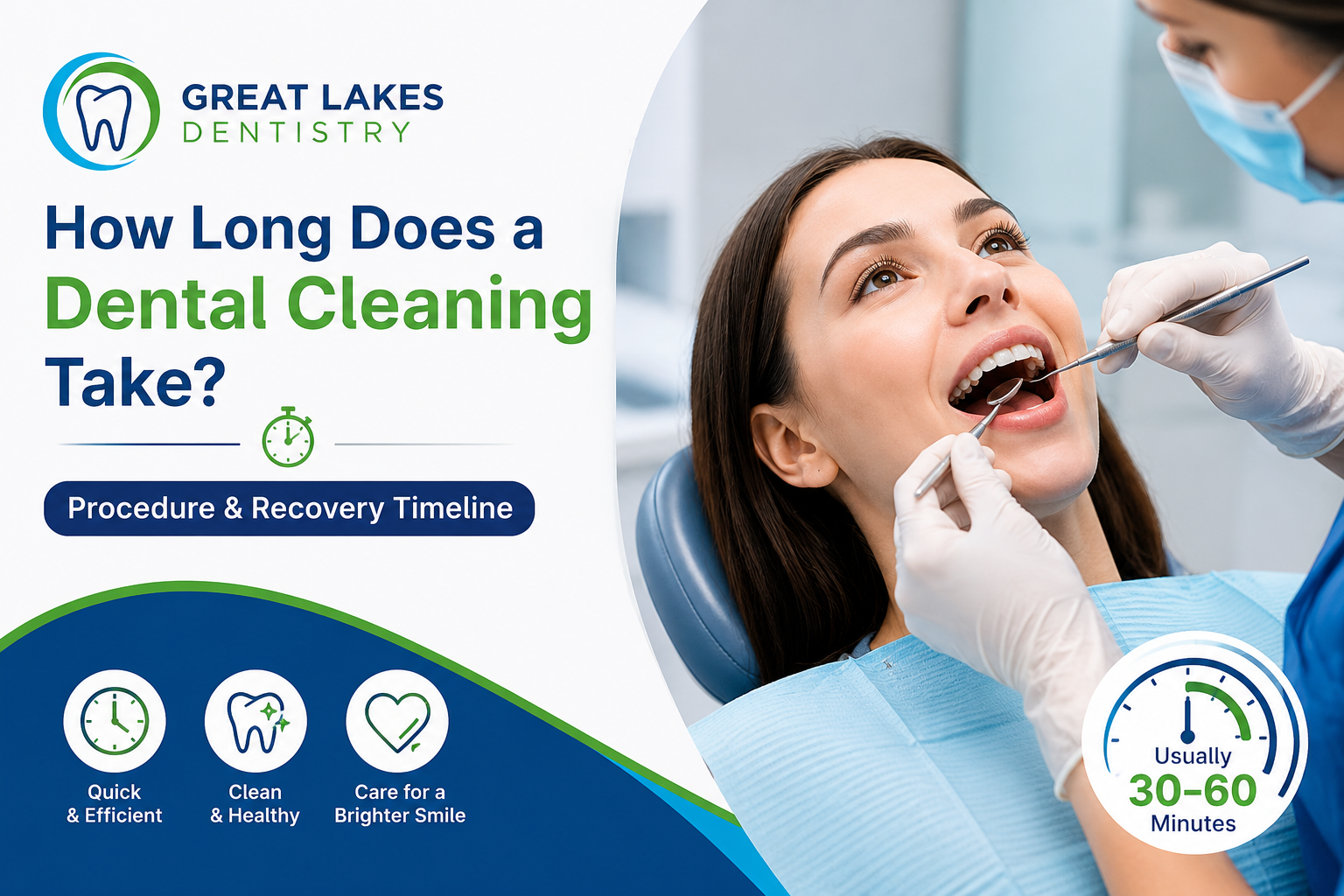
How Long Does a Dental Cleaning Take? What to Expect
Medically reviewed by Dr. Gurpreet Mohi, DDS — Great Lakes Dentistry, Oakville, Ontario
If you’ve ever booked a dental cleaning and wondered, “How much time should I actually block off for this?” you’re not alone. Many Oakville patients arrive unsure whether to expect a quick 30-minute visit or a longer appointment — and the honest answer is that it depends on your gum health, how long it’s been since your last cleaning, and what type of cleaning you need.
At Great Lakes Dentistry, located at 3465 Rebecca St, Unit 105, Oakville, ON, our team walks every patient through what to expect before their appointment begins. In this guide, we break down exactly how long a dental cleaning takes, what happens at each stage, and why some visits run longer than others.
Average Dental Cleaning Times at a Glance
- Routine cleaning (prophylaxis): 30 to 60 minutes, with most healthy adults finishing around 45 minutes.
- New patient appointment: 60 to 90 minutes, since baseline X-rays and a full dental history are usually needed.
- Periodontal maintenance cleaning: Around 45 to 60 minutes per visit, typically repeated every 3 to 4 months.
- Deep cleaning (scaling and root planing): 45 to 90 minutes per quadrant, often split across two or more appointments.
- Children’s cleaning: Usually 20 to 30 minutes, since there’s typically less buildup and fewer surfaces to treat.
These ranges cover the vast majority of patients, though your dentist or hygienist may need more or less time depending on your specific oral health.
What Happens During a Routine Dental Cleaning
A standard cleaning appointment at our family dentistry practice generally follows the same sequence for every patient:
1. Review and Oral Exam
Your hygienist starts by reviewing your dental history and taking a visual look at your teeth and gums, checking for early signs of decay, gum inflammation, or other concerns. If X-rays are due, this is when they’re typically taken, which can add 10 to 20 minutes to the appointment.
2. Scaling
Scaling is the process of removing plaque and hardened tartar from the tooth surfaces and along the gumline, usually using a combination of an ultrasonic scaler and hand instruments. This is often the most time-intensive step, since the amount of buildup directly affects how long it takes.
3. Polishing
Once your teeth are free of tartar, your hygienist polishes them with a gritty paste and a rotating handpiece. This step removes surface stains and leaves your teeth feeling smooth, and typically only takes a few minutes.
4. Flossing and Rinse
Your hygienist flosses between every tooth to clear any remaining debris and check for bleeding, which can be an early sign of gum disease. A final rinse removes any leftover polish or debris.
5. Fluoride Treatment (If Recommended)
Some patients receive a fluoride treatment at the end of the cleaning to help strengthen enamel and reduce cavity risk. This adds only a few minutes but is usually left to set for a short time before eating or drinking.
6. Dentist Examination
After the cleaning, the dentist typically reviews the hygienist’s findings, examines your bite and any areas of concern, and may perform an oral cancer screening. If any treatment is needed, this is when it’s discussed.
What Affects How Long Your Cleaning Takes
- Amount of plaque and tartar buildup: The biggest factor. Tartar that has hardened over months or years takes longer to remove safely than light plaque.
- Time since your last cleaning: Patients who are overdue for a visit typically need more time, since there’s more to clean and a fuller set of X-rays may be required.
- Gum health: Inflamed or bleeding gums require a more careful, gentle approach, which can extend the appointment.
- Dental work already in your mouth: Crowns, bridges, implants, and orthodontic appliances create more surfaces to clean carefully.
- Whether it’s a new patient visit: First-time appointments usually take longer because your hygienist and dentist are building a complete picture of your oral health.
- Your comfort level: Patients with dental anxiety or sensitive teeth may need brief breaks throughout, which can add time but is always worth it for a comfortable experience.
Routine Cleaning vs. Deep Cleaning: Why the Time Differs So Much
It’s worth understanding the difference between a routine cleaning and a deep cleaning, since patients are sometimes surprised by how much longer the latter takes.
A routine cleaning, also called a prophylaxis, is designed for patients with generally healthy gums and works only on the visible tooth surfaces and just below the gumline. A deep cleaning, known clinically as scaling and root planing, is recommended when gum disease has caused pockets to form between the teeth and gums. Because this requires cleaning below the gumline and around the tooth root, it’s more involved, is often done with local anesthetic, and is typically split into two or more appointments — treating one side of the mouth per visit rather than the whole mouth at once. This staged approach keeps each session more comfortable and allows the gums to begin healing between visits.
Types of Dental Cleanings Explained
Not every cleaning is the same, and knowing which type you’re scheduled for can help set the right expectations for time and comfort:
- Prophylaxis (routine cleaning): The standard preventive cleaning for patients with healthy gums, focused on removing plaque and tartar above and just below the gumline.
- Gross debridement: A more thorough first-pass cleaning for patients who haven’t had a professional cleaning in a long time or have heavier buildup than a routine cleaning can address in one visit.
- Periodontal maintenance: An ongoing cleaning schedule for patients who have already been treated for gum disease, aimed at preventing it from returning.
- Scaling and root planing (deep cleaning): A targeted treatment for active gum disease, cleaning below the gumline and smoothing the tooth root to help gum tissue reattach.
Your dentist will recommend the right category based on your gum health, X-ray findings, and how long it’s been since your last visit — which is also the biggest reason two people can have very different appointment lengths for what sounds like the same “cleaning.”
How to Make Your Cleaning Appointment Go Faster
- Keep up with regular six-month visits, since consistent cleanings mean less buildup for your hygienist to remove each time.
- Brush twice daily and floss once a day between visits to minimize plaque accumulation.
- Arrive a few minutes early to complete any paperwork so your appointment time is fully spent on care.
- Let your hygienist know about any sensitivity or anxiety in advance — our sedation dentistry options can help pace the visit accordingly.
Is a Longer Cleaning a Bad Sign?
Not at all. A longer appointment usually just means your hygienist is being thorough, whether that’s because it’s your first visit, you have more buildup than usual, or you have restorative work that needs careful attention. Quality of care matters far more than the clock — your dental team should always take the time needed to clean gently and completely, and speak up if you ever feel rushed or uncomfortable.
Important: Only your dentist can accurately assess how long your specific cleaning should take. Never assume a shorter visit means a job well done, or that a longer one signals a problem. Book a cleaning at Great Lakes Dentistry to find out exactly what your appointment will involve.
What to Expect at Great Lakes Dentistry — Your Oakville Dental Home
At Great Lakes Dentistry, we’ve been serving the Oakville community for over 10 years. Under the leadership of Dr. Gurpreet Mohi, our team provides painless, patient-first cleanings in a warm, welcoming environment, backed by modern digital X-ray technology, flexible scheduling, and transparent, upfront pricing.
If you’re overdue for a visit or unsure which type of cleaning applies to you, our teeth cleaning team can walk you through what to expect based on your dental history — no judgment, no surprises.
Trusted Resources on Dental Cleanings
For more information on professional dental cleanings and gum health, we recommend these trusted sources:
- Canadian Dental Association — Professional Cleaning Guidance
- Health Canada — Dental Health Guidelines
- World Health Organization — Oral Health Facts
These organizations provide evidence-based dental care recommendations for Canadians.
Frequently Asked Questions About Dental Cleanings in Oakville
Most adults benefit from a professional cleaning every six months. Patients with gum disease or a higher risk of cavities may need cleanings every three to four months instead.
A routine cleaning shouldn’t cause pain, though some patients feel mild sensitivity during scaling, especially if they have inflamed gums or sensitive teeth. Deep cleanings are typically done with a local anesthetic to keep the area comfortable.
New patient appointments usually take longer, often 60 to 90 minutes, because your dentist needs to gather a full dental history, take baseline X-rays, and complete a comprehensive exam before the cleaning itself begins.
Yes, in most cases. If you received a fluoride treatment, your hygienist will likely recommend waiting 30 minutes before eating or drinking so the fluoride has time to absorb properly.
Deep cleanings treat gum disease below the gumline, which requires more time, precision, and often local anesthetic. Splitting treatment into two or more visits, usually by quadrant or by side of the mouth, keeps each session more comfortable and allows the gums to begin healing in between.
No. Children’s cleanings are typically shorter, often 20 to 30 minutes, since there’s usually less plaque buildup and fewer surfaces involved compared to an adult’s teeth.
Final Thoughts
Key Takeaways on Dental Cleaning Times:
- Most routine cleanings take 30 to 60 minutes, averaging around 45 minutes.
- New patient visits and deep cleanings take longer due to X-rays, history-taking, and below-the-gumline treatment.
- The biggest factor in appointment length is how much plaque and tartar has built up since your last visit.
- A longer cleaning isn’t a bad sign — it usually just means your hygienist is being thorough.
- Staying on a consistent six-month schedule is the easiest way to keep future cleanings quick and comfortable.
Book Your Dental Cleaning in Oakville Today
The team at Great Lakes Dentistry is welcoming new and returning patients. Call us at (905) 825-1212 or book online — we look forward to caring for your smile.
About the Reviewer
Dr. Gurpreet Mohi, DDS is the primary dentist at Great Lakes Dentistry in Oakville, Ontario, with a clinical focus on preventive and family dental care, including routine cleanings and periodontal maintenance.
- Preventive and restorative dental care
- Comfortable, patient-centred approach
- Early detection and minimally invasive treatment
- Comprehensive care for the whole family
This article is provided for educational purposes. For personalized dental advice specific to your oral health needs, consult Dr. Gurpreet Mohi or the team at Great Lakes Dentistry, Oakville, Ontario.