
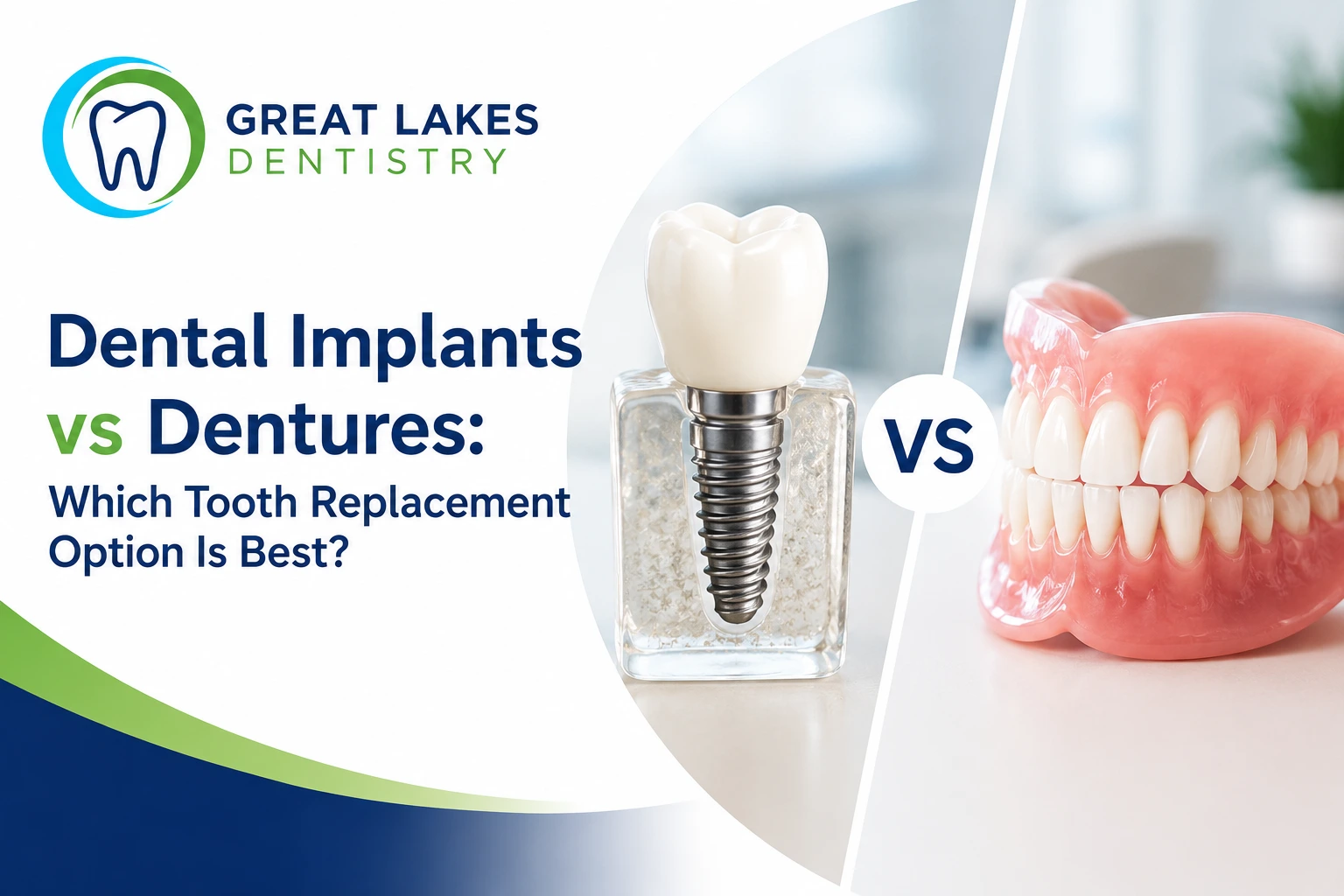
Choosing between dental implants and dentures depends on your oral health, lifestyle, and long-term goals
Dental Implants vs Dentures: Which Tooth Replacement Option Is Best?
If you’ve lost one or more teeth, you’ve likely come across two common solutions: dental implants and dentures. Both can restore your smile and chewing ability, but they work very differently — and the right choice depends on your oral health, budget, and lifestyle. In this guide, we break down the differences in detail so you can make an informed decision with confidence.
Understanding the Basics: What Are Dental Implants?
A dental implant is a titanium post surgically placed into the jawbone to replace a missing tooth root. Once the implant has fused with the bone through a process called osseointegration, a custom crown, bridge, or full arch prosthesis is attached on top. The result looks, feels, and functions much like a natural tooth.
Implants can replace a single tooth, several teeth, or — in the case of full mouth dental implants — an entire arch using techniques like All-on-4 or All-on-6.
Understanding the Basics: What Are Dentures?
Dentures are removable appliances designed to replace some or all of your natural teeth. They sit on top of the gums and are held in place by suction, adhesive, or — in the case of implant-supported overdentures — by attachment to a small number of implants.
There are two main types:
- Complete dentures — replace an entire arch of missing teeth
- Partial dentures — fill in gaps where some natural teeth remain
Dentures have been used for centuries and remain a practical, lower-cost option for many patients, particularly those who are not candidates for surgery or who prefer a non-invasive solution.
Dental Implants vs Dentures: Side-by-Side Comparison
Choosing between these two options often comes down to a handful of key factors. Here’s how they compare:
| Factor | Dental Implants | Dentures |
|---|---|---|
| Stability | Fixed, does not move | Can shift or slip, especially when eating |
| Jawbone health | Stimulates bone, prevents shrinkage | Does not stimulate bone — jaw continues to shrink over time |
| Appearance | Looks and feels like a natural tooth | Can look artificial, especially as gums change shape |
| Comfort | No irritation from movement | May cause sore spots or require adhesives |
| Diet | Near-normal eating, including harder foods | Some hard or sticky foods may need to be avoided |
| Maintenance | Brush and floss like natural teeth | Requires daily removal, cleaning, and soaking |
| Longevity | 15–25+ years with proper care | Typically need relining or replacement every 5–8 years |
| Initial cost | Higher upfront investment | Lower upfront cost |
| Procedure | Requires minor surgery and healing time | Non-surgical, faster to obtain |
Neither option is universally “better” — the right choice depends on your unique oral health, budget, and goals. A consultation at Great Lakes Dentistry can help determine which path makes the most sense for you.
The Case for Dental Implants
For many patients, implants represent the closest possible match to natural teeth. Here’s why so many people choose them:
Bone Preservation
When a tooth is lost, the jawbone beneath it begins to resorb due to lack of stimulation. Dental implants replicate the function of a natural tooth root, signaling the bone to maintain its density. This helps preserve facial structure over the long term — something dentures cannot do.
Stability and Confidence
Because implants are anchored directly into the bone, there’s no risk of slipping while talking, laughing, or eating. Many denture wearers report anxiety about their appliance shifting in social situations — implants eliminate this concern entirely.
Long-Term Value
While the upfront cost of implants is higher, they are designed to last 15 to 25 years or longer with proper care. Dentures, by comparison, often need relining, adjustment, or full replacement every 5 to 8 years as the jawbone and gums change shape — these recurring costs can add up significantly over a lifetime.
According to the Canadian Dental Association, dental implants are widely regarded as the gold standard for tooth replacement because they are the only option that addresses both the visible tooth and the underlying root structure.
The Case for Dentures
Dentures remain a valuable and appropriate solution for many patients, particularly in these situations:
Lower Upfront Cost
For patients on a tighter budget or without dental insurance coverage for implants, dentures provide an immediate, more affordable way to restore appearance and basic chewing function.
Non-Surgical Option
Some patients have medical conditions that make oral surgery higher risk, or simply prefer to avoid surgical procedures altogether. Dentures require no incisions, implants, or healing period before use.
Faster Turnaround
Conventional dentures can often be fabricated and fitted in a matter of weeks, compared to the multi-month timeline typically required for implants (which includes a healing period for osseointegration).
A Middle Ground: Implant-Supported Overdentures
For patients who like the affordability of dentures but want more stability, an implant-supported overdenture offers a hybrid solution. A small number of implants (often two to four) anchor a removable denture in place, dramatically improving stability and slowing bone loss compared to traditional dentures — all at a lower cost than a full fixed-arch implant restoration.
Who Should Consider Dental Implants?
You may be a strong candidate for implants if:
- You have adequate jawbone density (or are open to bone grafting)
- You are in good general health without uncontrolled systemic conditions
- You want a permanent, low-maintenance solution
- You are frustrated with slipping or uncomfortable dentures
- You are a non-smoker or willing to quit during healing
Patients with significant bone loss are not automatically excluded — procedures like bone grafting or zygomatic implants can often create a viable foundation. A thorough evaluation, including 3D imaging, is the best way to determine candidacy.
Who Should Consider Dentures?
Dentures may be the right fit if:
- You are looking for a more affordable tooth replacement option
- You have health conditions that make surgery riskier
- You need a faster solution with minimal downtime
- You have significant bone loss and prefer to avoid extensive grafting
- You’re interested in implant-supported overdentures as a middle-ground option
How the Decision Process Works at Great Lakes Dentistry
Choosing between implants and dentures isn’t something you need to figure out alone. At Great Lakes Dentistry, the process typically includes:
- A comprehensive oral exam, including digital X-rays and 3D imaging where needed
- An honest discussion of your goals, budget, and lifestyle
- A review of your candidacy for implants, including bone density assessment
- A transparent, written cost comparison of all viable options
- Guidance on insurance coverage and the Canadian Dental Care Plan (CDCP)
Our family dentistry approach means we treat patients of all ages, and our sedation dentistry options ensure anxious patients feel comfortable throughout any procedure — implant or otherwise.
Maintenance: What Daily Life Looks Like With Each Option
Living With Dental Implants
Caring for implants is virtually identical to caring for natural teeth — brush twice daily, floss (or use interdental brushes), and attend regular professional cleanings. There’s no removal, no soaking, and no special adhesives required.
Living With Dentures
Dentures require nightly removal for cleaning and soaking, careful handling to avoid damage, and periodic adjustments as your gums and bone change shape over time. Some patients also use adhesive for extra security throughout the day.
What If You Already Have Dentures and Are Considering a Switch?
Many long-term denture wearers eventually explore implants due to bone loss, discomfort, or frustration with slipping appliances. The good news is that even patients who have worn dentures for years can often transition to implants — though bone grafting may be necessary first to rebuild a stable foundation.
If you’re dealing with a damaged restoration in the meantime, our emergency dentist team is available to help with urgent repairs while you explore longer-term solutions. And if a dental bridge is a better fit for a smaller gap, we can discuss that option as well.
Trusted Resources on Tooth Replacement Options
For further reading from authoritative sources, we recommend:
- Canadian Dental Association — Oral Health Resources
- Health Canada — Dental Care Guidelines
- World Health Organization — Oral Health Facts
Not Sure Which Option Is Right for You?
The team at Great Lakes Dentistry is here to help you weigh your options with honest, personalized guidance. Call us at (905) 825-1212 or book online for a comprehensive consultation with Dr. Gurpreet Mohi.
Frequently Asked Questions: Dental Implants vs Dentures
Are dental implants more expensive than dentures?
Yes, the upfront cost of dental implants is typically higher than dentures. However, dentures often require relining, adjustment, or replacement every 5 to 8 years, while implants can last 15 to 25 years or longer with proper care — making implants more cost-effective over time for many patients.
Can I switch from dentures to implants later on?
In many cases, yes. Long-term denture wearers can often transition to implants, though bone grafting may be needed first to rebuild areas of jawbone that have shrunk over time. A 3D CT scan at Great Lakes Dentistry can determine the best path forward for your specific situation.
Do dentures cause bone loss?
Traditional dentures do not stimulate the jawbone the way natural tooth roots or implants do, which means the bone beneath them can gradually shrink over time. This is one of the key long-term differences compared to dental implants, which help preserve bone density.
Which option is more comfortable, implants or dentures?
Most patients find implants more comfortable in the long run because they are fixed in place and do not shift, rub, or require adhesives. Dentures can sometimes cause sore spots or feel loose, particularly as the gums and bone change shape over the years.
What is an implant-supported overdenture?
An implant-supported overdenture is a removable denture that snaps onto two or more implants for added stability. It offers a middle ground — significantly more secure than traditional dentures, while typically more affordable than a fully fixed full-arch implant restoration.
Are dental implants covered by insurance in Ontario?
Coverage varies by plan. Some dental insurance policies provide partial coverage for implant-related procedures, and eligible patients may receive benefits through the Canadian Dental Care Plan (CDCP). Great Lakes Dentistry’s team can help verify your coverage and submit claims on your behalf.
How do I know which option is right for me?
The best way to decide is through a comprehensive consultation that includes a clinical exam, imaging, and an honest discussion of your goals and budget. Dr. Mohi will walk you through the pros and cons of each option based on your specific oral health needs before recommending a treatment path.
Final Thoughts
Key Takeaways: Dental Implants vs Dentures
- Dental implants offer a fixed, permanent solution that preserves jawbone density and looks and feels most like natural teeth
- Dentures provide a more affordable, non-surgical option, but may shift over time and don’t prevent bone loss
- Implant-supported overdentures offer a middle ground between cost and stability
- Implants typically last 15–25+ years; dentures often need replacement every 5–8 years
- The right choice depends on your bone health, budget, lifestyle, and long-term goals
- A professional consultation is the best way to determine which option fits your needs