
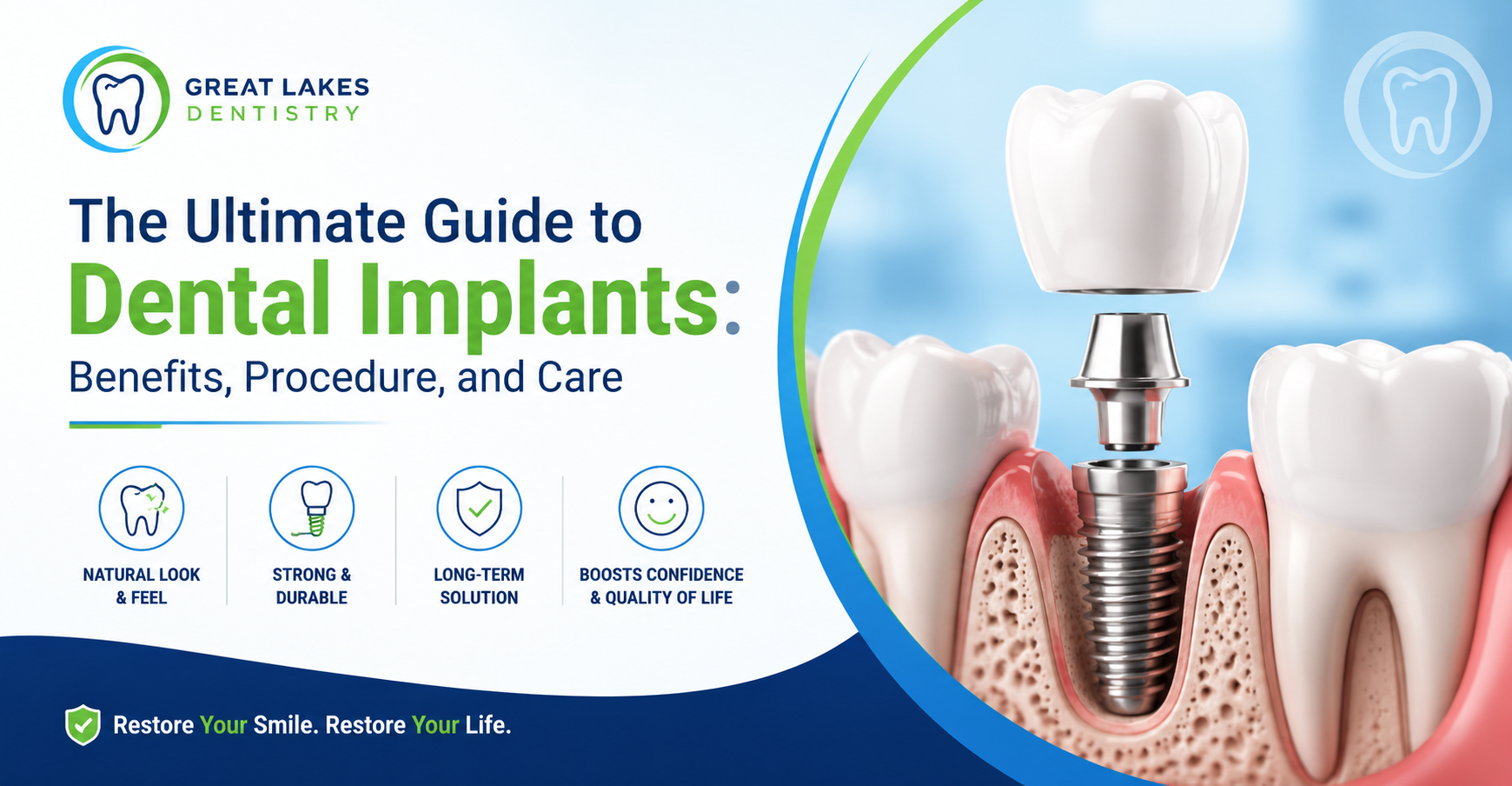
Dental implants replace missing tooth roots permanently — Great Lakes Dentistry, Oakville
The Ultimate Guide to Dental Implants: Benefits, Procedure, and Care
Dental implants are the gold standard for replacing missing teeth. Learn about the procedure, benefits, costs, and how to care for your implants for life.
What Are Dental Implants?
A dental implant is a small titanium post surgically inserted into the jawbone to replace the root of a missing tooth. Once placed, it fuses naturally with the bone through a process called osseointegration — creating a permanent foundation for a custom crown, bridge, or denture.
Unlike removable options, implants are the only restoration that replaces the tooth root itself. If you are also exploring dental bridges or dental crowns as alternatives, our team at Great Lakes Dentistry can help you compare what is right for your situation.
Key Understanding
Unlike dentures or bridges, implants are fixed permanently inside your jaw — they do not shift, slip, or require adhesives.
The Three Parts of a Dental Implant
- The Implant Post: A titanium screw surgically placed into the jawbone — the artificial root
- The Abutment: A small connector sitting just above the gum line, linking the post to the restoration
- The Crown: The custom-made, tooth-coloured prosthetic that looks and acts like your real tooth
Key Benefits of Dental Implants
They Look and Feel Like Real Teeth
Every implant crown at Great Lakes Dentistry is custom-designed to match the exact shape, size, and shade of your surrounding teeth. Once in place, neither you nor anyone else can tell the difference.
They Are Permanent and Long-Lasting
With proper care, the titanium post can last a lifetime. Studies consistently report dental implant success rates above 95% over 10 years — making them the most durable tooth replacement option available today.
They Protect Your Jawbone and Facial Structure
When a tooth is lost, the jawbone beneath it begins to deteriorate. Dental implants are the only tooth replacement that actively stimulates the jawbone — preventing bone loss and preserving your natural facial contours.
They Do Not Harm Adjacent Teeth
Traditional dental bridges require permanently grinding down the healthy teeth on either side. Implants stand entirely on their own, leaving all surrounding teeth completely untouched.
Are You a Good Candidate?
- Healthy gums with no active periodontal disease
- Sufficient jawbone density to support the implant post
- Non-smoker, or willing to quit smoking during the healing phase
- No uncontrolled systemic conditions such as unmanaged diabetes
- Committed to good oral hygiene and regular professional cleanings
- Age 18 or older with fully developed jawbones (no upper age limit)
The Dental Implant Procedure: Step by Step
Step 1: Initial Consultation and Digital Imaging
A comprehensive assessment includes a full dental exam, digital X-rays, and 3D imaging to evaluate jawbone density and map the precise implant position. You leave with a clear written treatment plan and transparent cost estimate. Learn more about our family dentistry approach to patient-first care.
Step 2: Tooth Extraction (If Required)
If the damaged tooth is still present, it is removed first. In select cases, implant placement can happen the same day as extraction. Our team also offers wisdom tooth extractions and complex removal procedures with the same gentle care.
Step 3: Bone Graft (If Needed)
Patients with insufficient bone density require a bone graft before implant placement. The graft material integrates over three to six months, creating a solid base for the implant.
Step 4: Implant Post Placement Surgery
Under local anesthesia, the titanium post is gently inserted into the jawbone using minimally invasive surgical techniques. The procedure typically takes one to two hours per implant. Nervous about the procedure? Our sedation dentistry options ensure a calm, comfortable experience.
Step 5: Osseointegration — The Healing Phase
Over the next three to six months, the implant post fuses with your jawbone. A temporary crown is usually worn during this time so your smile stays intact.
Step 6: Abutment Placement
Once osseointegration is confirmed, the abutment is attached to the post. A brief healing period of one to two weeks follows.
Step 7: Final Crown, Bridge, or Denture Placement
Your custom restoration — colour-matched and shaped to blend with your natural teeth — is permanently secured. Your new tooth is fully functional, beautiful, and built to last. Explore our dental crowns page to understand how we design and place restorations.
Types of Dental Implant Solutions
- Single Tooth Implant: One implant post with one crown — ideal for replacing an individual missing tooth
- Multiple Tooth Implants: Two or more independent implants for several non-adjacent missing teeth
- Implant-Supported Bridge: Two implants anchor a bridge replacing several adjacent missing teeth
- Implant-Supported Dentures: Snap-on or fixed dentures anchored to implants — far more stable than conventional removable dentures
- All-on-4 / Full Arch Implants: Four strategically placed implants support a complete upper or lower arch
Dental Implants vs. Dentures
Dental Implants
Fixed and permanent, stimulates bone, no slipping, full natural bite force, brush and floss like real teeth.
Traditional Dentures
Removable and temporary, bone loss continues, can loosen over time, reduced chewing ability, requires adhesives and nightly removal.
How to Care for Your Dental Implants
What To Do
- Brush twice daily with a soft-bristled toothbrush and non-abrasive toothpaste
- Floss daily using implant-specific floss or a water flosser
- Use an antibacterial mouthwash daily
- Drink plenty of water and maintain good hydration
- Book regular professional cleanings every six months
What NOT To Do
- Do not eat extremely hard or sticky foods that could stress the crown
- Do not smoke — tobacco significantly increases the risk of implant failure
- Do not skip regular professional checkups
- Do not ignore any persistent pain, swelling, or looseness — contact our emergency dentist team immediately
Dental Implant Cost in Oakville, Ontario
- Typical range: $1,500 to $6,000 per implant
- Cost varies based on the number of implants, type of restoration, and whether bone grafting is needed
- Implants are more cost-effective over a lifetime than bridges or dentures
- Flexible payment plans and direct insurance billing available at Great Lakes Dentistry
Potential Risks and How We Minimise Them
- Infection at the implant site — rare with proper sterile technique and post-operative care
- Implant failure — more common in smokers or patients with uncontrolled diabetes
- Minor nerve sensitivity — usually temporary and avoided through 3D imaging-guided planning
- Sinus complications with upper jaw implants — prevented through careful pre-surgical evaluation
Recovery Timeline After Implant Surgery
- Most patients return to normal daily activities within one to two days
- Gum tissue heals within one to two weeks
- Full osseointegration (bone fusion) takes three to six months
Concerned about pain during recovery? Our sedation dentistry options and pain-conscious care protocols ensure you are comfortable at every stage.
Did You Know? Cavities Can Affect Implant Candidates
Before moving forward with dental implants, it is important that any existing tooth decay or cavities are treated. Active decay and gum disease must be resolved to ensure a healthy foundation for implant placement.
When NOT to Delay — Seek Care If You Notice:
- Persistent pain or throbbing after the healing phase
- Facial or gum swelling that worsens
- Fever accompanying tooth or implant pain
- Pus or foul taste near the implant site
- A feeling that the implant is loose or shifting
Our emergency dentist team is available to help you promptly.
Why Oakville Patients Choose Great Lakes Dentistry
- Led by Dr. Gurpreet Mohi, Primary Dentist with extensive implant experience
- Advanced 3D digital imaging for millimetre-precise implant planning
- Fully personalised treatment plans tailored to your anatomy, goals, and budget
- Sedation dentistry available for anxious patients
- Transparent pricing with written estimates, flexible payment plans, and direct insurance billing
- Conveniently located at 3465 Rebecca St, Unit 105, Oakville — serving Oakville, Burlington, Mississauga, and surrounding areas
- 4,500+ happy patients
Dental Implants and Your Overall Oral Health
Maintaining your implants long-term starts with a strong oral health foundation. Regular professional teeth cleanings keep the gum tissue around your implant healthy and free from bacteria. Our family dentistry services ensure your whole family benefits from the same preventive-first philosophy.
If you are also considering cosmetic improvements alongside implants, teeth whitening or Invisalign can complement your new smile beautifully.
Prevention: Keeping Your Implants Healthy for Life
- Brush with a soft-bristled toothbrush and fluoride toothpaste
- Floss daily around the implant base
- Limit hard, sticky, or sugary foods
- Drink water frequently
- Schedule regular dental exams every six months
Concerned About a Missing Tooth?
Early evaluation leads to simpler, more affordable treatment. Book your consultation with Dr. Gurpreet Mohi today.
Book Appointment
Expert Dental Care in Oakville
At Great Lakes Dentistry, patients receive comprehensive evaluations, digital diagnostics, and minimally invasive implant treatments — all within a calm, patient-first environment.
Frequently Asked Questions
How long do dental implants last?
With proper care, the titanium post can last a lifetime. The crown typically lasts 15 to 25 years before it may need replacement due to normal wear and tear.
Is the dental implant procedure painful?
The surgery is performed under local anesthesia, so you will feel no pain during the procedure. Mild soreness and swelling in the days following are normal and easily managed with over-the-counter pain relievers. Anxious patients can also benefit from our sedation dentistry options.
How long is the recovery after implant surgery?
Most patients return to normal daily activities within one to two days. Full osseointegration — the bone fusion that makes the implant permanent — takes three to six months, but this process is entirely painless.
Are dental implants covered by insurance in Ontario?
Coverage depends on your specific insurance plan. We offer direct insurance billing and flexible payment plans to help make implants financially accessible. Eligible patients may also receive support through the Canada Dental Care Plan (CDCP).
Can I get dental implants if I have bone loss?
Yes — in many cases. A bone grafting procedure can rebuild bone volume before implant placement. Our team will evaluate your bone density using 3D imaging and recommend the best approach.
Can seniors get dental implants?
Absolutely. There is no upper age limit for dental implants. The key factors are overall health, gum health, and bone quality — not age.
What is the difference between dental implants and bridges?
Bridges require permanently grinding down healthy adjacent teeth to act as supports. Implants stand completely independently, leaving all surrounding healthy teeth untouched and intact.
Do I need to treat cavities before getting implants?
Yes. Any active tooth decay or gum disease must be treated before implant placement to ensure long-term success.
How do I get started at Great Lakes Dentistry?
Simply contact our Oakville dental clinic to schedule your initial consultation. We are accepting new patients and look forward to welcoming you.
Understanding Coverage & Patient Support
Canada Dental Care Plan (CDCP)
Eligible patients may receive coverage for necessary treatments through the Canada Dental Care Plan. Contact our office to verify your eligibility and coverage details.
Health Information Resources
For reliable oral health guidance:
These organizations provide evidence-based dental care recommendations.
Final Thoughts
- Less invasive treatment options
- Lower long-term costs
- Reduced risk of bone loss
- Better preservation of adjacent teeth